
R E D W O O D T R U S T . C O M Q1 2026 Redwood Review April 29, 2026 Exhibit 99.3
2 Cautionary Statement/ Forward-Looking Statements This presentation contains forward-looking statements, including statements regarding our 2026 forward outlook and strategic priorities, key drivers to increase earnings, book value, mortgage banking volumes and market share and statements regarding the target acquisition volume for our joint venture with Castlelake of $8 billion of prime jumbo loans. Forward-looking statements involve numerous risks and uncertainties. Our actual results may differ from our beliefs, expectations, estimates, and projections and, consequently, you should not rely on these forward-looking statements as predictions of future events. Forward-looking statements are not historical in nature and can be identified by words such as “anticipate,” “estimate,” “will,” “should,” “expect,” “believe,” “intend,” “seek,” “plan” and similar expressions or their negative forms, or by references to strategy, plans, opportunities, or intentions. These forward-looking statements are subject to risks and uncertainties, including, among other things, those described in the Company’s Annual Report on Form 10- K for the year ended December 31, 2025 and any subsequent Quarterly Reports on Form 10-K, Form 10-Q and Form 8-K under the caption “Risk Factors.” Other risks, uncertainties, and factors that could cause actual results to differ materially from those projected may be described from time to time in reports the Company files with the Securities and Exchange Commission, including Current Reports on Form 8-K. Additionally, this presentation contains estimates and information concerning our industry, including market size and growth rates of the markets in which we participate, that are based on industry publications and reports. This information involves many assumptions and limitations, and you are cautioned not to give undue weight to these estimates. We have not independently verified the accuracy or completeness of the data contained in these industry publications and reports. The industry in which we operate is subject to a high degree of uncertainty and risk due to a variety of factors, including those referred to above, that could cause results to differ materially from those expressed in these publications and reports.
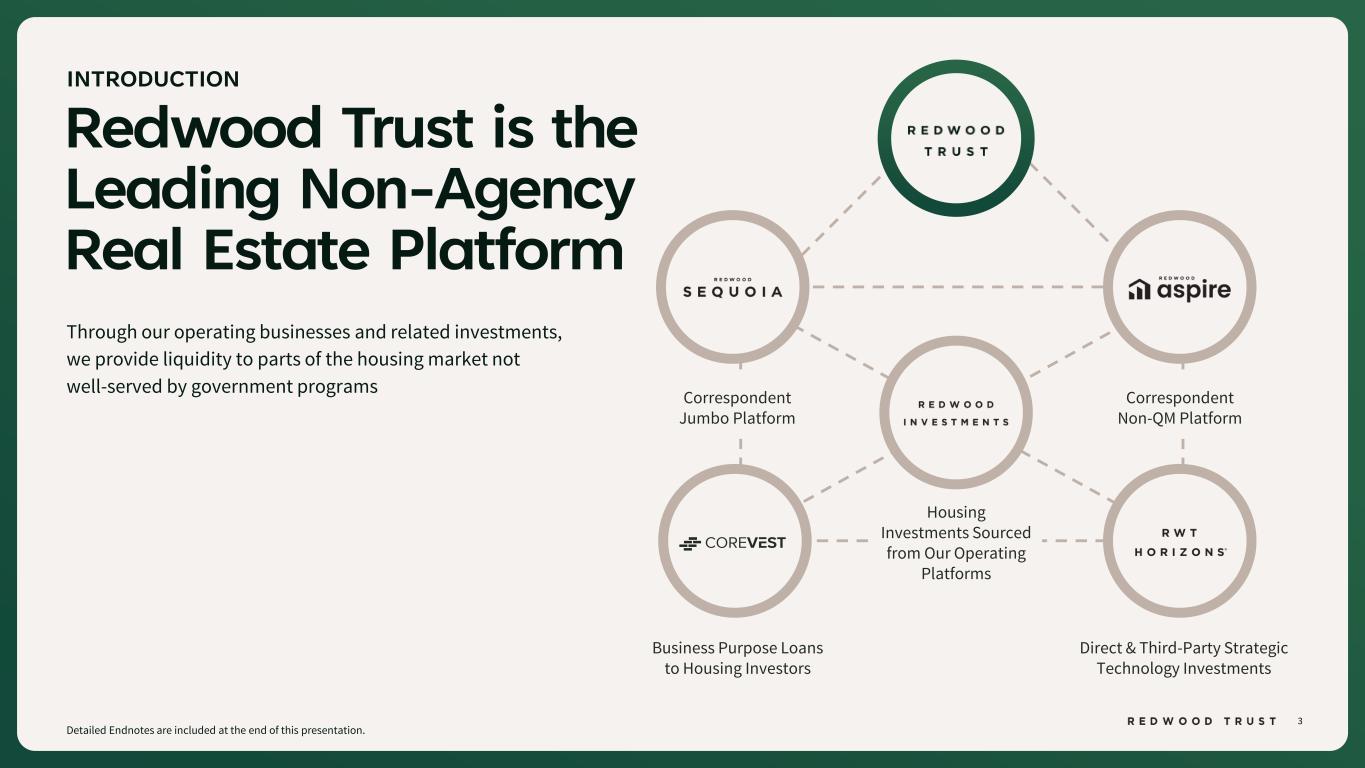
3 Redwood Trust is the Leading Non-Agency Real Estate Platform INTRODUCTION Detailed Endnotes are included at the end of this presentation. Correspondent Non-QM Platform Correspondent Jumbo Platform Direct & Third-Party Strategic Technology Investments Business Purpose Loans to Housing Investors Housing Investments Sourced from Our Operating Platforms Through our operating businesses and related investments, we provide liquidity to parts of the housing market not well-served by government programs
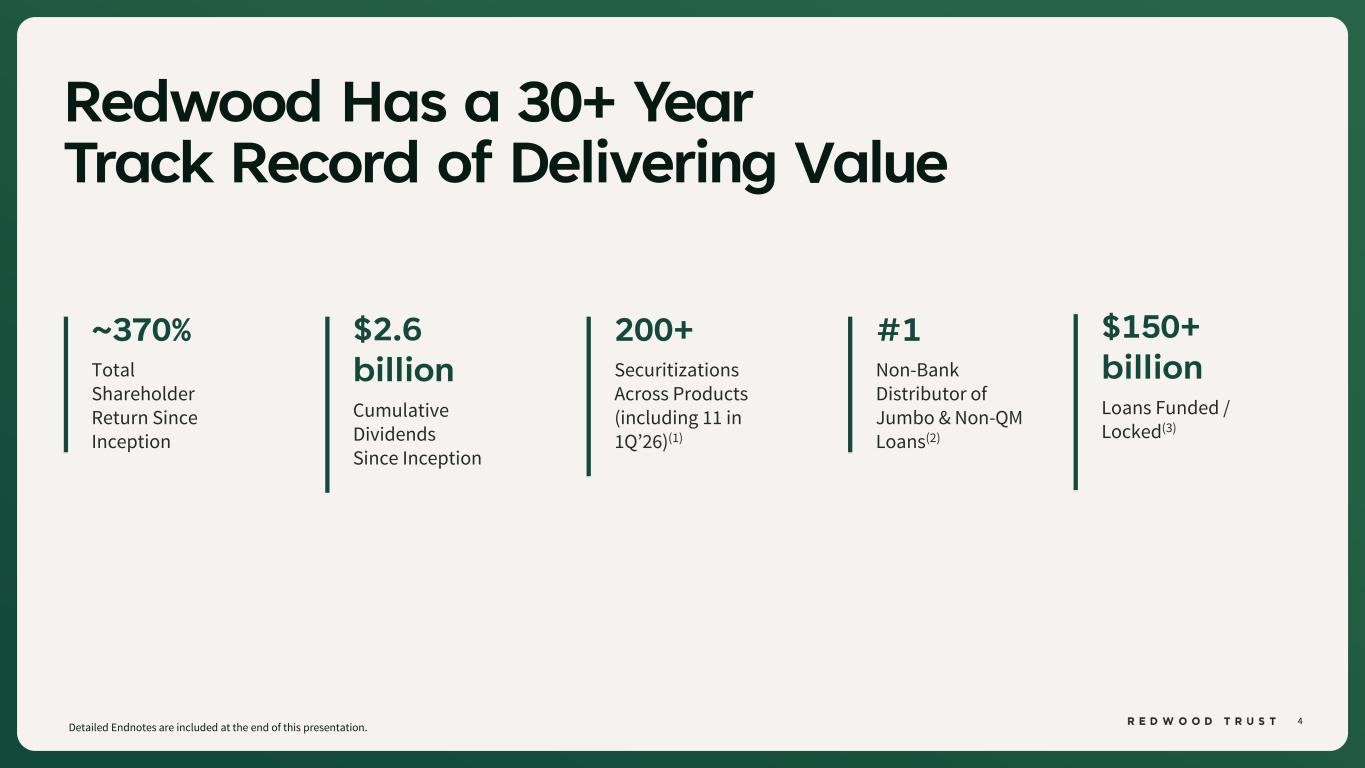
4 #1 Non-Bank Distributor of Jumbo & Non-QM Loans(2) Detailed Endnotes are included at the end of this presentation. ~370% Total Shareholder Return Since Inception $2.6 billion Cumulative Dividends Since Inception 200+ Securitizations Across Products (including 11 in 1Q’26)(1) $150+ billion Loans Funded / Locked(3) Redwood Has a 30+ Year Track Record of Delivering Value
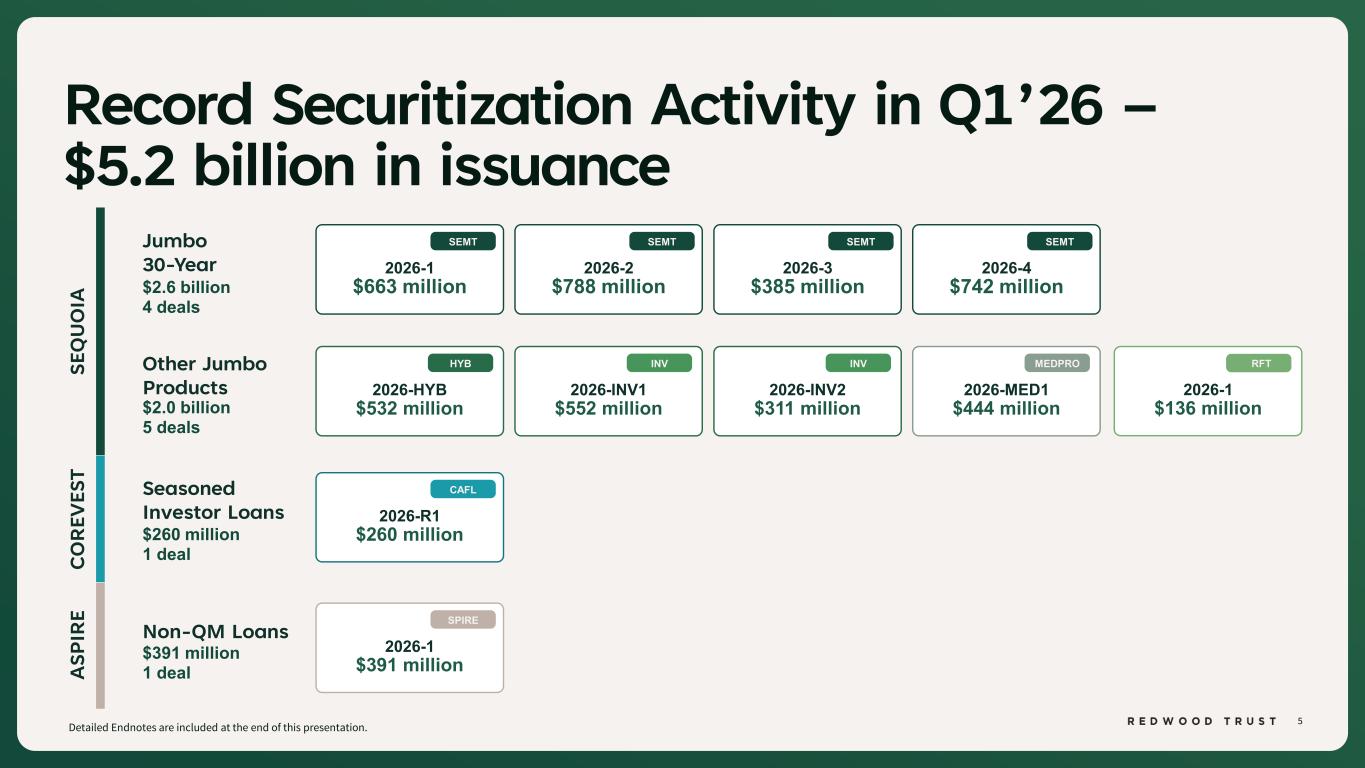
5 Detailed Endnotes are included at the end of this presentation. Record Securitization Activity in Q1’26 – $5.2 billion in issuance Jumbo 30-Year $2.6 billion 4 deals Other Jumbo Products $2.0 billion 5 deals Seasoned Investor Loans $260 million 1 deal Non-QM Loans $391 million 1 deal SE QU OI A CO RE VE ST AS PI RE SPIRE 2026-1 $391 million CAFL 2026-R1 $260 million HYB 2026-HYB $532 million INV 2026-INV1 $552 million INV 2026-INV2 $311 million MEDPRO 2026-MED1 $444 million SEMT 2026-1 $663 million SEMT 2026-2 $788 million SEMT 2026-3 $385 million SEMT 2026-4 $742 million RFT 2026-1 $136 million

6 Castlelake and Redwood Trust Announce Strategic Joint Venture Detailed Endnotes are included at the end of this presentation. • Today we announced a new strategic joint venture to support profitable mortgage banking growth Why it Matters • Scalable platform capacity, including the potential acquisition of seasoned bank loans • Aligns Redwood with a global investor with a large, diversified institutional capital base • Improves capital efficiency, allowing Sequoia to scale production with less capital per loan • Meaningful annual EPS accretion for Redwood, with additional upside through structured economics JV Partners (1) Asset Class Prime Jumbo Loans Purchasing Power Up to $8 billion
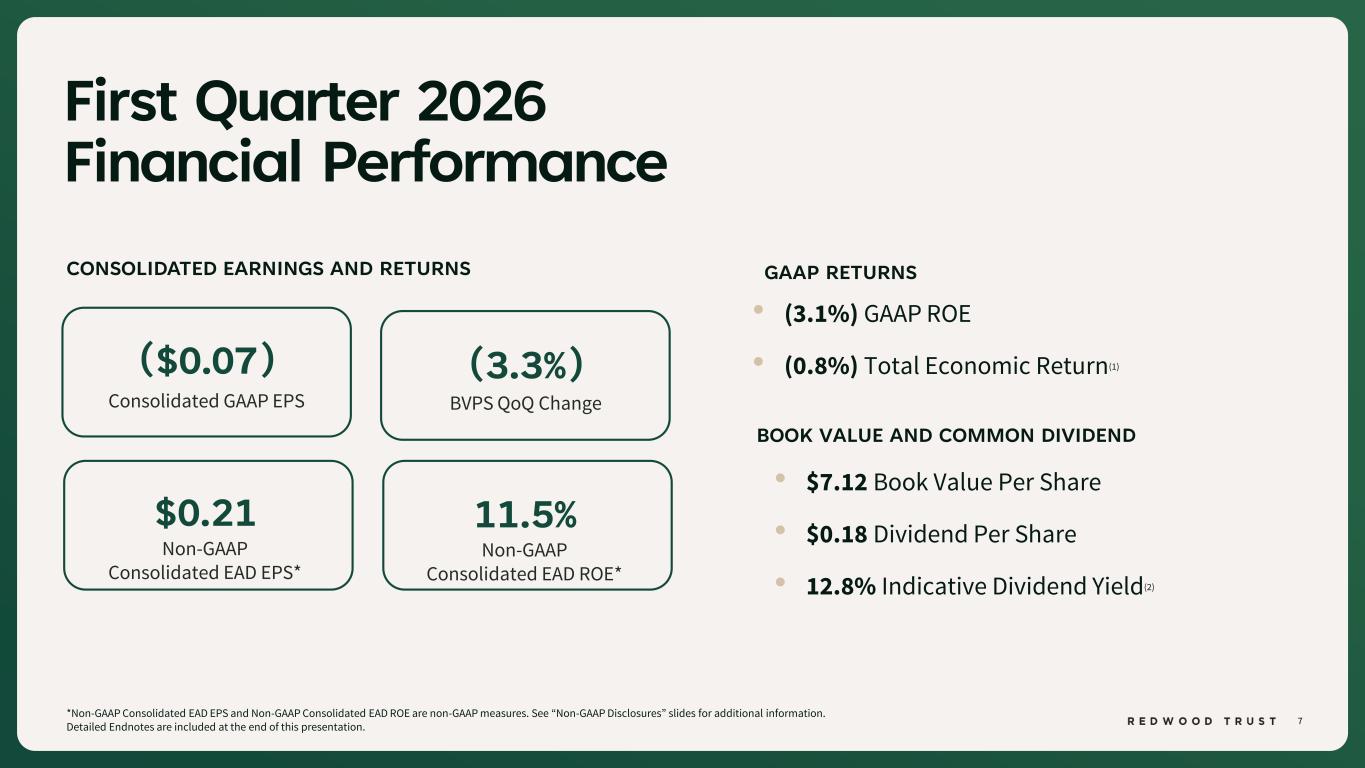
7 First Quarter 2026 Financial Performance *Non-GAAP Consolidated EAD EPS and Non-GAAP Consolidated EAD ROE are non-GAAP measures. See “Non-GAAP Disclosures” slides for additional information. Detailed Endnotes are included at the end of this presentation. CONSOLIDATED EARNINGS AND RETURNS GAAP RETURNS • $7.12 Book Value Per Share • $0.18 Dividend Per Share • 12.8% Indicative Dividend Yield(2) ($0.07) Consolidated GAAP EPS (3.3%) BVPS QoQ Change $0.21 Non-GAAP Consolidated EAD EPS* 11.5% Non-GAAP Consolidated EAD ROE* BOOK VALUE AND COMMON DIVIDEND • (3.1%) GAAP ROE • (0.8%) Total Economic Return(1)
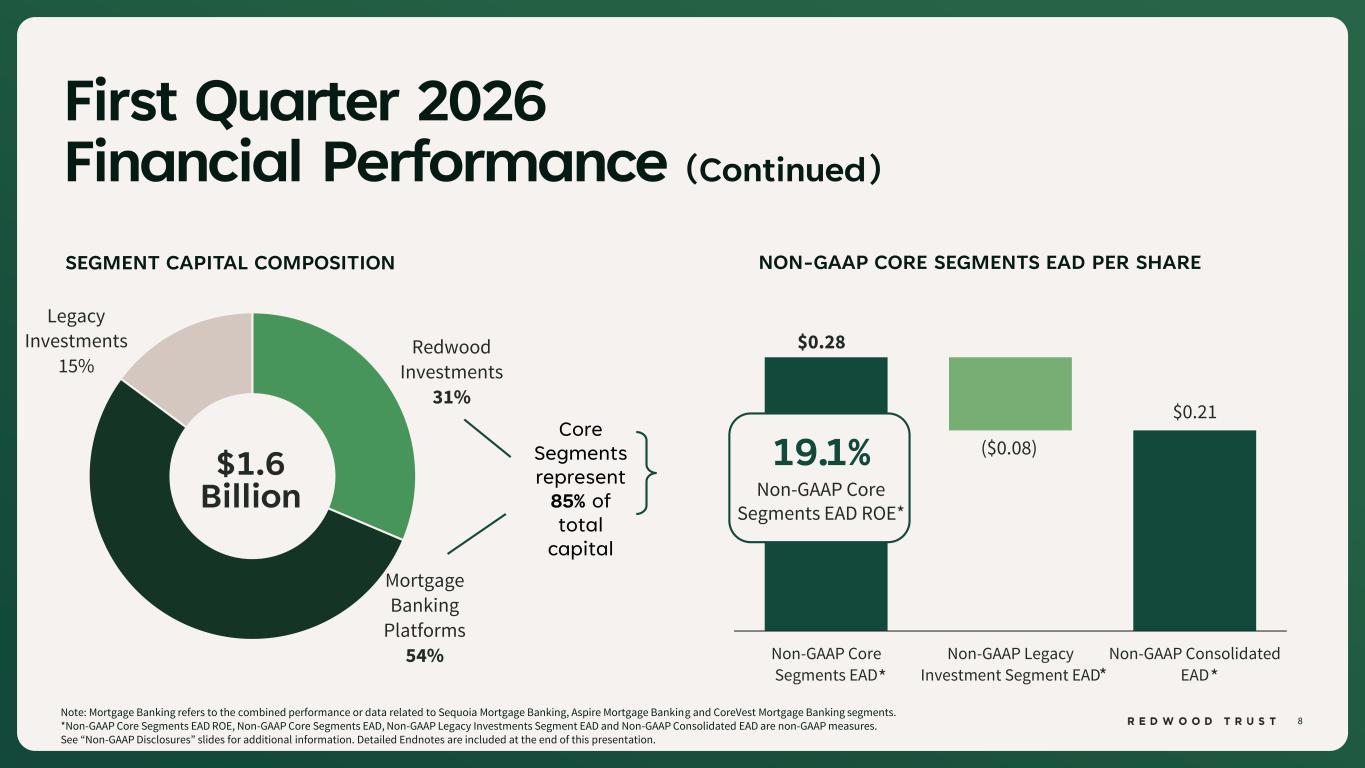
8 Redwood Investments 31% Mortgage Banking Platforms 54% Legacy Investments 15% First Quarter 2026 Financial Performance (Continued) SEGMENT CAPITAL COMPOSITION Core Segments represent 85% of total capital $1.6 Billion NON-GAAP CORE SEGMENTS EAD PER SHARE $0.28 $0.21 ($0.08) Non-GAAP Core Segments EAD Non-GAAP Legacy Investment Segment EAD Non-GAAP Consolidated EAD 19.1% Non-GAAP Core Segments EAD ROE* * * * Note: Mortgage Banking refers to the combined performance or data related to Sequoia Mortgage Banking, Aspire Mortgage Banking and CoreVest Mortgage Banking segments. *Non-GAAP Core Segments EAD ROE, Non-GAAP Core Segments EAD, Non-GAAP Legacy Investments Segment EAD and Non-GAAP Consolidated EAD are non-GAAP measures. See “Non-GAAP Disclosures” slides for additional information. Detailed Endnotes are included at the end of this presentation.
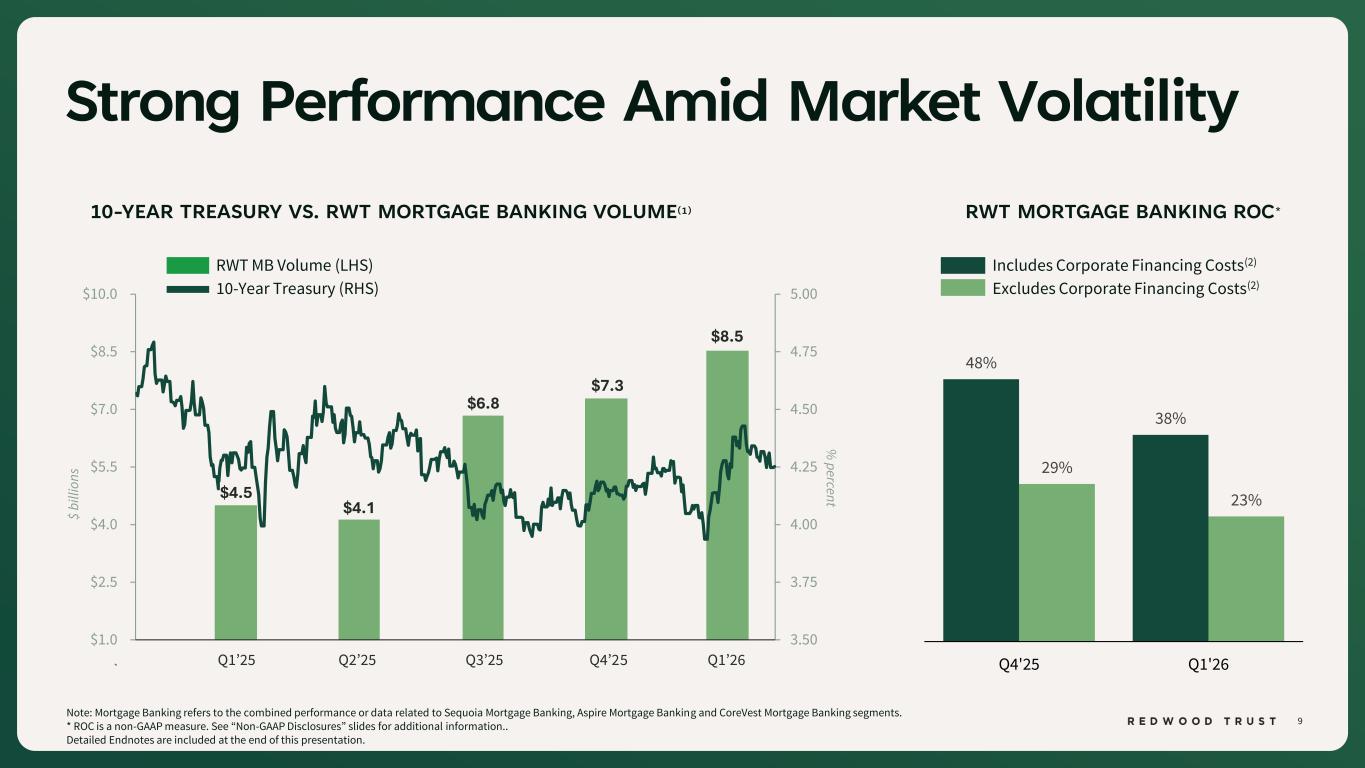
9 3.50 3.75 4.00 4.25 4.50 4.75 5.00 $1.0 $2.5 $4.0 $5.5 $7.0 $8.5 $10.0 Jan-25 Mar-25 May-25 Jul-25 Sep-25 Nov-25 Jan-26 Mar-26 Note: Mortgage Banking refers to the combined performance or data related to Sequoia Mortgage Banking, Aspire Mortgage Banking and CoreVest Mortgage Banking segments. * ROC is a non-GAAP measure. See “Non-GAAP Disclosures” slides for additional information.. Detailed Endnotes are included at the end of this presentation. 10-YEAR TREASURY VS. RWT MORTGAGE BANKING VOLUME(1) Strong Performance Amid Market Volatility $ b ill io n s $8.5 $7.3 $6.8 $4.1 $4.5 RWT MORTGAGE BANKING ROC* Includes Corporate Financing Costs(2) Excludes Corporate Financing Costs(2) Q1’25 Q2’25 Q3’25 Q4’25 Q1’26 RWT MB Volume (LHS) 10-Year Treasury (RHS) 48% 38% 29% 23% Q4'25 Q1'26 % p ercen t
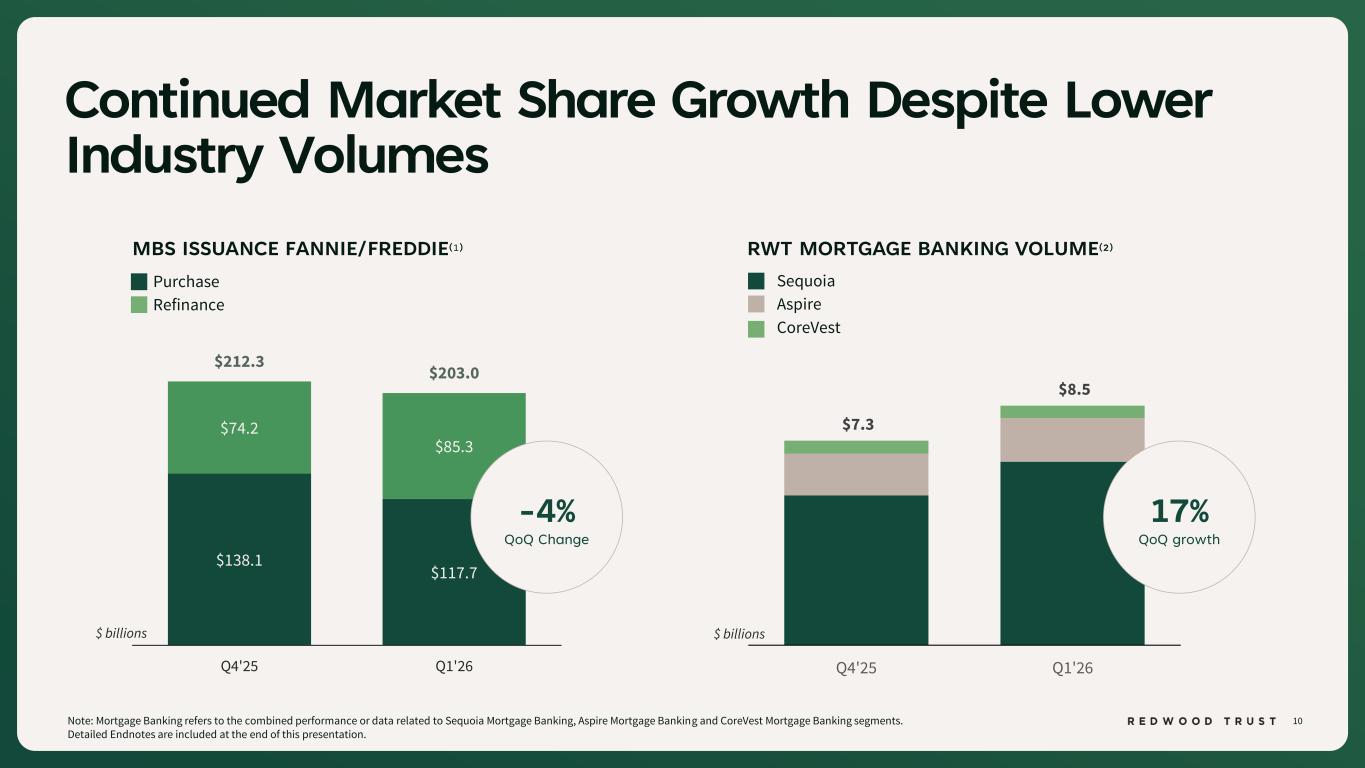
10Note: Mortgage Banking refers to the combined performance or data related to Sequoia Mortgage Banking, Aspire Mortgage Banking and CoreVest Mortgage Banking segments. Detailed Endnotes are included at the end of this presentation. MBS ISSUANCE FANNIE/FREDDIE(1) $138.1 $117.7 $74.2 $85.3 $212.3 $203.0 Q4'25 Q1'26 Purchase Refinance -4% QoQ Change Continued Market Share Growth Despite Lower Industry Volumes $ billions RWT MORTGAGE BANKING VOLUME(2) Sequoia Aspire CoreVest $7.3 $8.5 Q4'25 Q1'26 17% QoQ growth $ billions
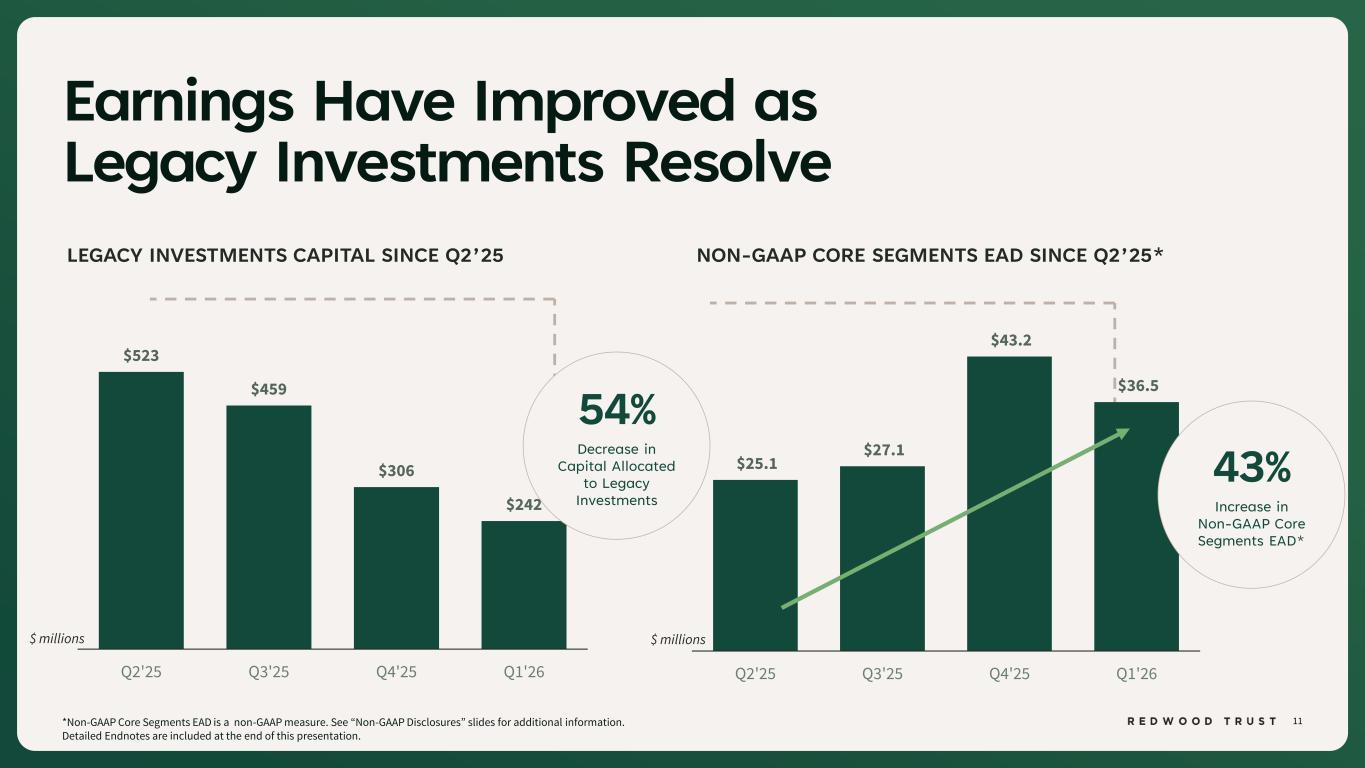
11 $25.1 $27.1 $43.2 $36.5 Q2'25 Q3'25 Q4'25 Q1'26 Earnings Have Improved as Legacy Investments Resolve LEGACY INVESTMENTS CAPITAL SINCE Q2’25 NON-GAAP CORE SEGMENTS EAD SINCE Q2’25* *Non-GAAP Core Segments EAD is a non-GAAP measure. See “Non-GAAP Disclosures” slides for additional information. Detailed Endnotes are included at the end of this presentation. $523 $459 $306 $242 Q2'25 Q3'25 Q4'25 Q1'26 54% Decrease in Capital Allocated to Legacy Investments 43% Increase in Non-GAAP Core Segments EAD* $ millions $ millions
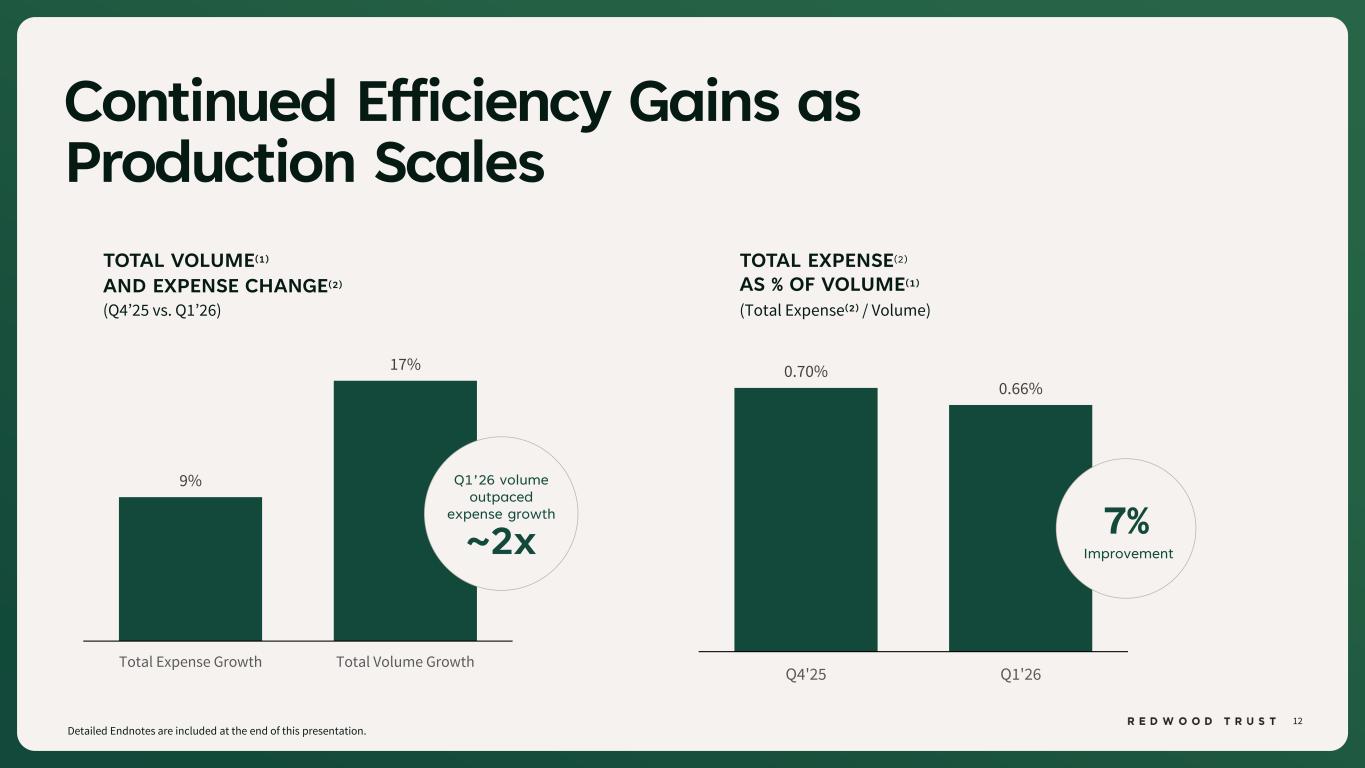
12 Detailed Endnotes are included at the end of this presentation. TOTAL VOLUME(1) AND EXPENSE CHANGE(2) (Q4’25 vs. Q1’26) Continued Efficiency Gains as Production Scales TOTAL EXPENSE(2) AS % OF VOLUME(1) (Total Expense(2) / Volume) 0.70% 0.66% Q4'25 Q1'26 7% Improvement 9% 17% Total Expense Growth Total Volume Growth Q1’26 volume outpaced expense growth ~2x
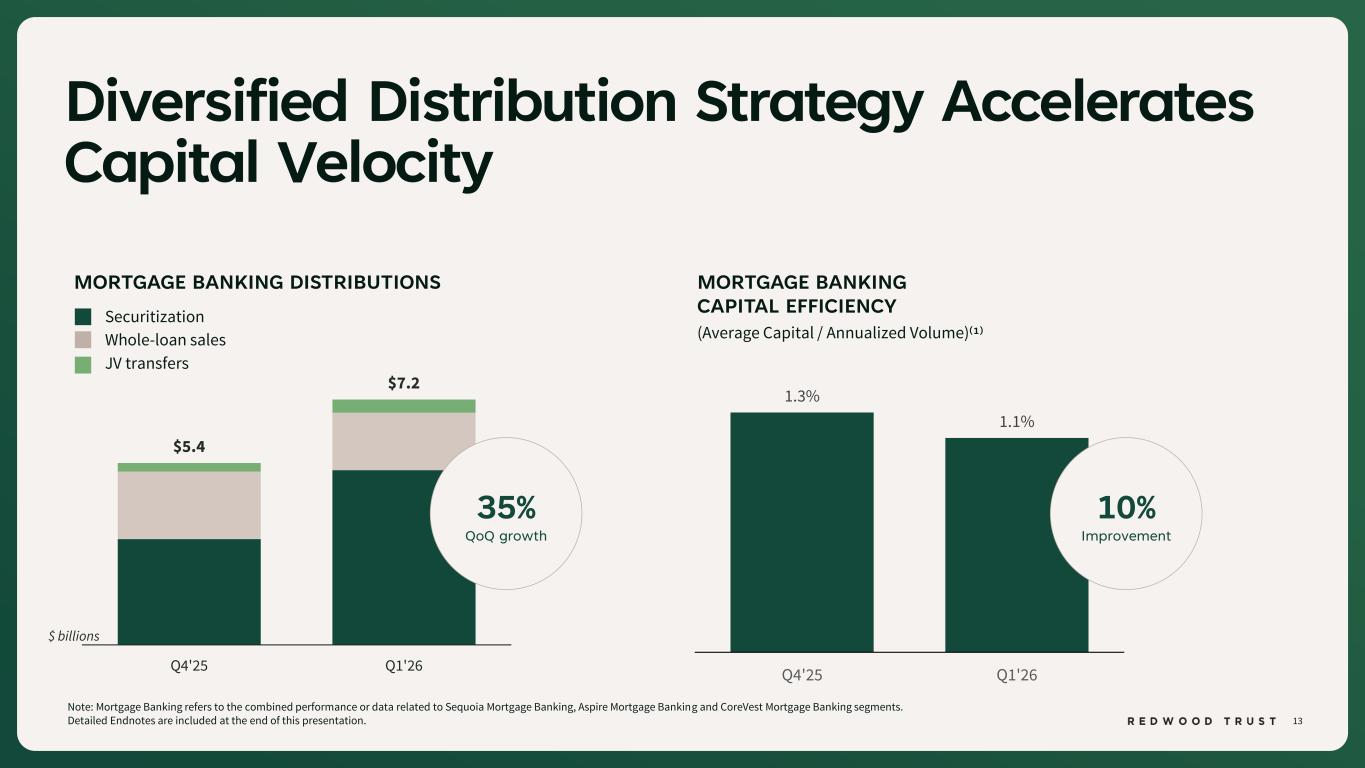
13 Note: Mortgage Banking refers to the combined performance or data related to Sequoia Mortgage Banking, Aspire Mortgage Banking and CoreVest Mortgage Banking segments. Detailed Endnotes are included at the end of this presentation. MORTGAGE BANKING CAPITAL EFFICIENCY (Average Capital / Annualized Volume)(1) Diversified Distribution Strategy Accelerates Capital Velocity 1.3% 1.1% Q4'25 Q1'26 10% Improvement $5.4 $7.2 Q4'25 Q1'26 35% QoQ growth MORTGAGE BANKING DISTRIBUTIONS Securitization Whole-loan sales JV transfers $ billions
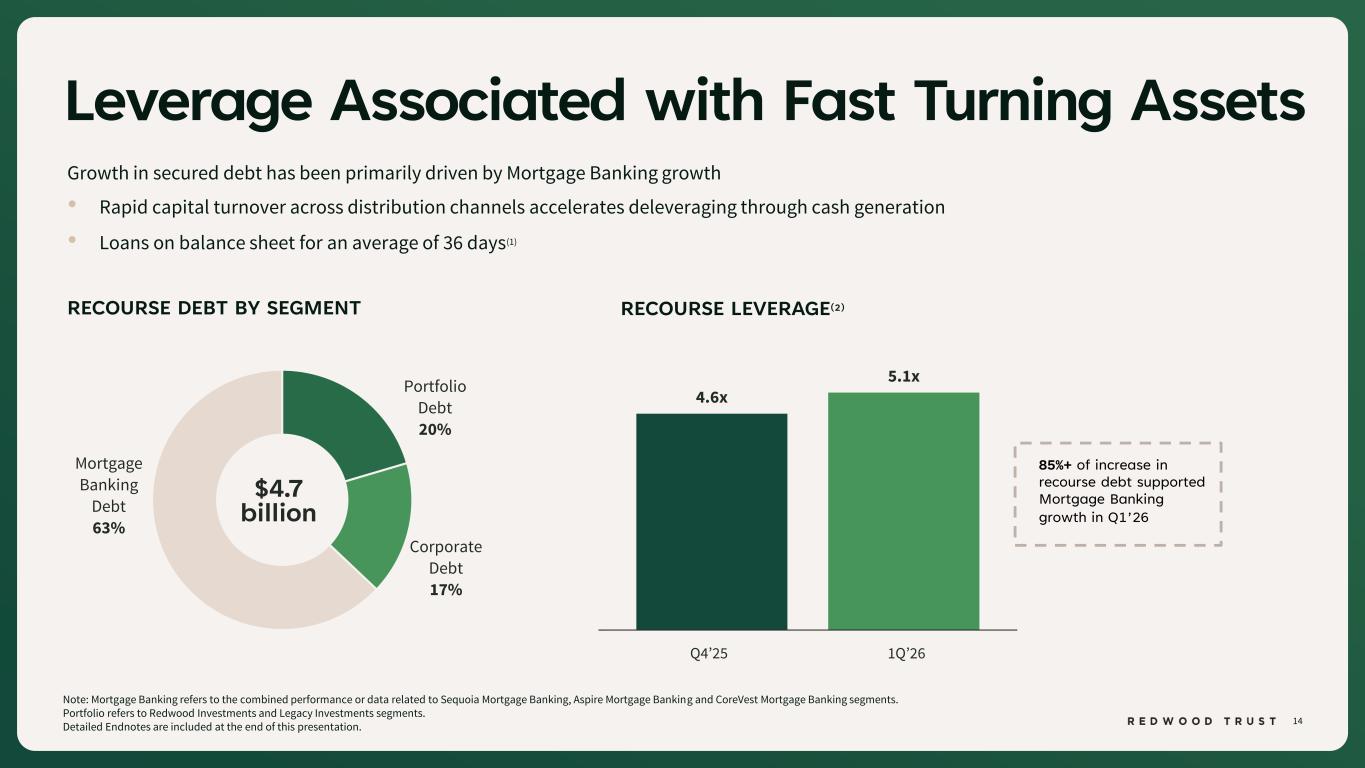
14 Leverage Associated with Fast Turning Assets Note: Mortgage Banking refers to the combined performance or data related to Sequoia Mortgage Banking, Aspire Mortgage Banking and CoreVest Mortgage Banking segments. Portfolio refers to Redwood Investments and Legacy Investments segments. Detailed Endnotes are included at the end of this presentation. RECOURSE DEBT BY SEGMENT Growth in secured debt has been primarily driven by Mortgage Banking growth • Rapid capital turnover across distribution channels accelerates deleveraging through cash generation • Loans on balance sheet for an average of 36 days(1) RECOURSE LEVERAGE(2) $4.7 billion 85%+ of increase in recourse debt supported Mortgage Banking growth in Q1’26 Portfolio Debt 20% Corporate Debt 17% Mortgage Banking Debt 63% 4.6x 5.1x TotalQ4’25 1Q’26
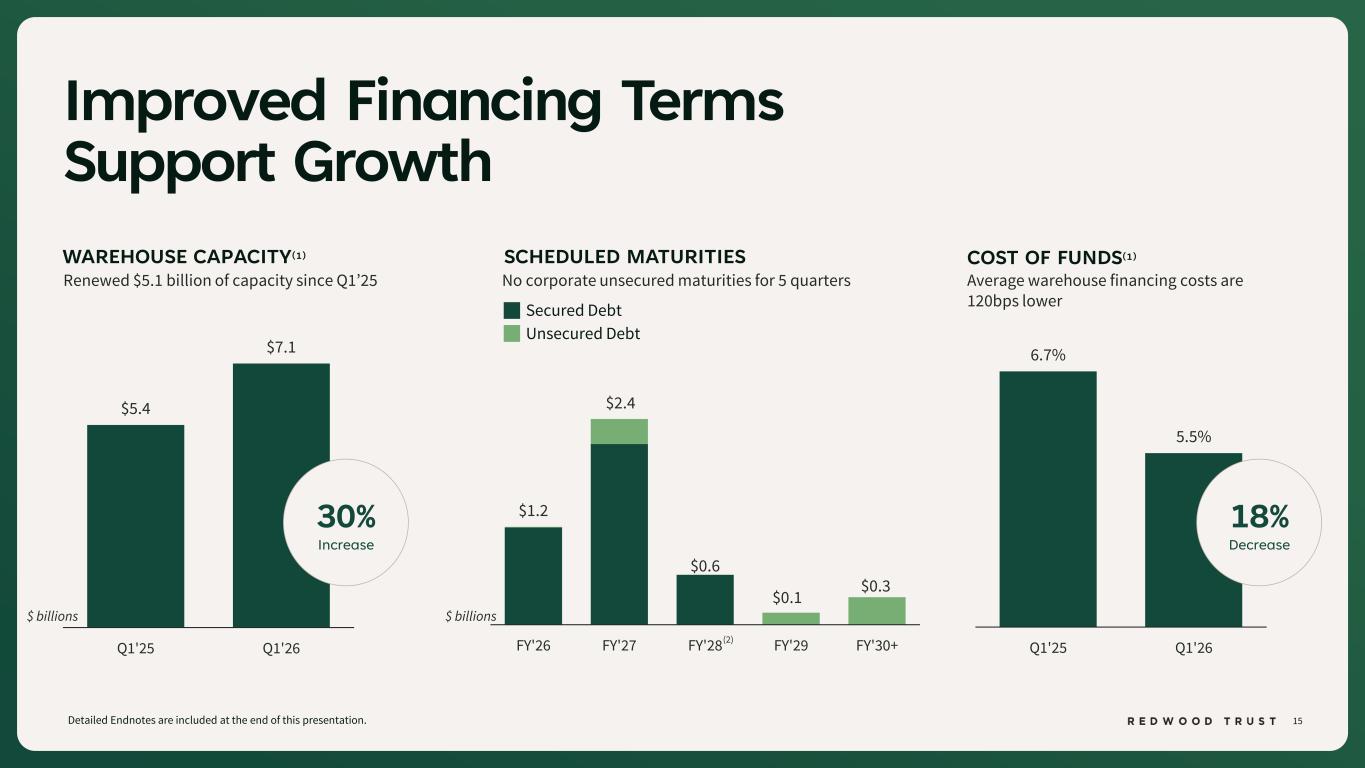
15 $5.4 $7.1 Q1'25 Q1'26 Improved Financing Terms Support Growth SCHEDULED MATURITIESWAREHOUSE CAPACITY(1) COST OF FUNDS(1) 30% Increase $ billions 6.7% 5.5% Q1'25 Q1'26 18% Decrease Average warehouse financing costs are 120bps lower No corporate unsecured maturities for 5 quartersRenewed $5.1 billion of capacity since Q1’25 $ billions Detailed Endnotes are included at the end of this presentation. Secured Debt Unsecured Debt $1.2 $2.4 $0.6 $0.1 $0.3 FY'26 FY'27 FY'28 FY'29 FY'30+ (2)
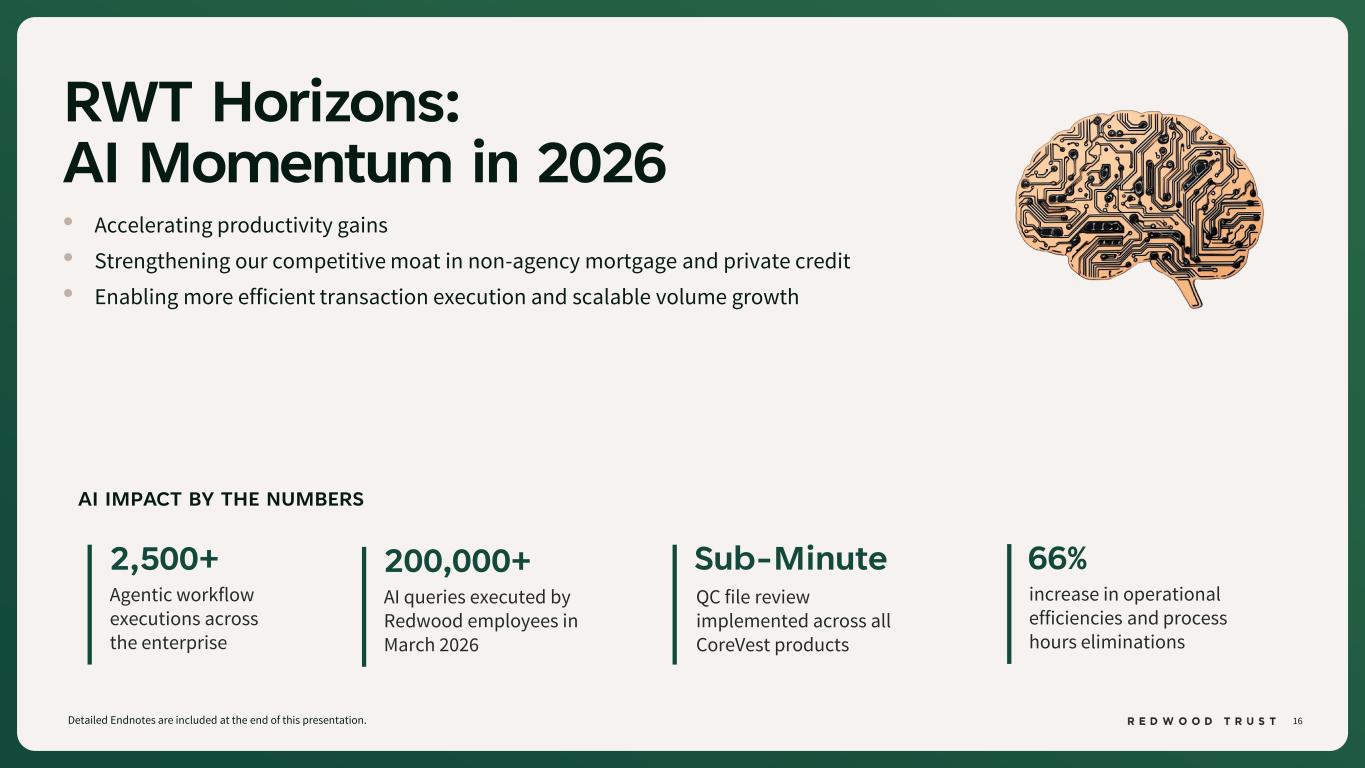
16 RWT Horizons: AI Momentum in 2026 AI IMPACT BY THE NUMBERS AI queries executed by Redwood employees in March 2026 200,000+ Agentic workflow executions across the enterprise 2,500+ QC file review implemented across all CoreVest products Sub-Minute increase in operational efficiencies and process hours eliminations 66% • Accelerating productivity gains • Strengthening our competitive moat in non-agency mortgage and private credit • Enabling more efficient transaction execution and scalable volume growth Detailed Endnotes are included at the end of this presentation.
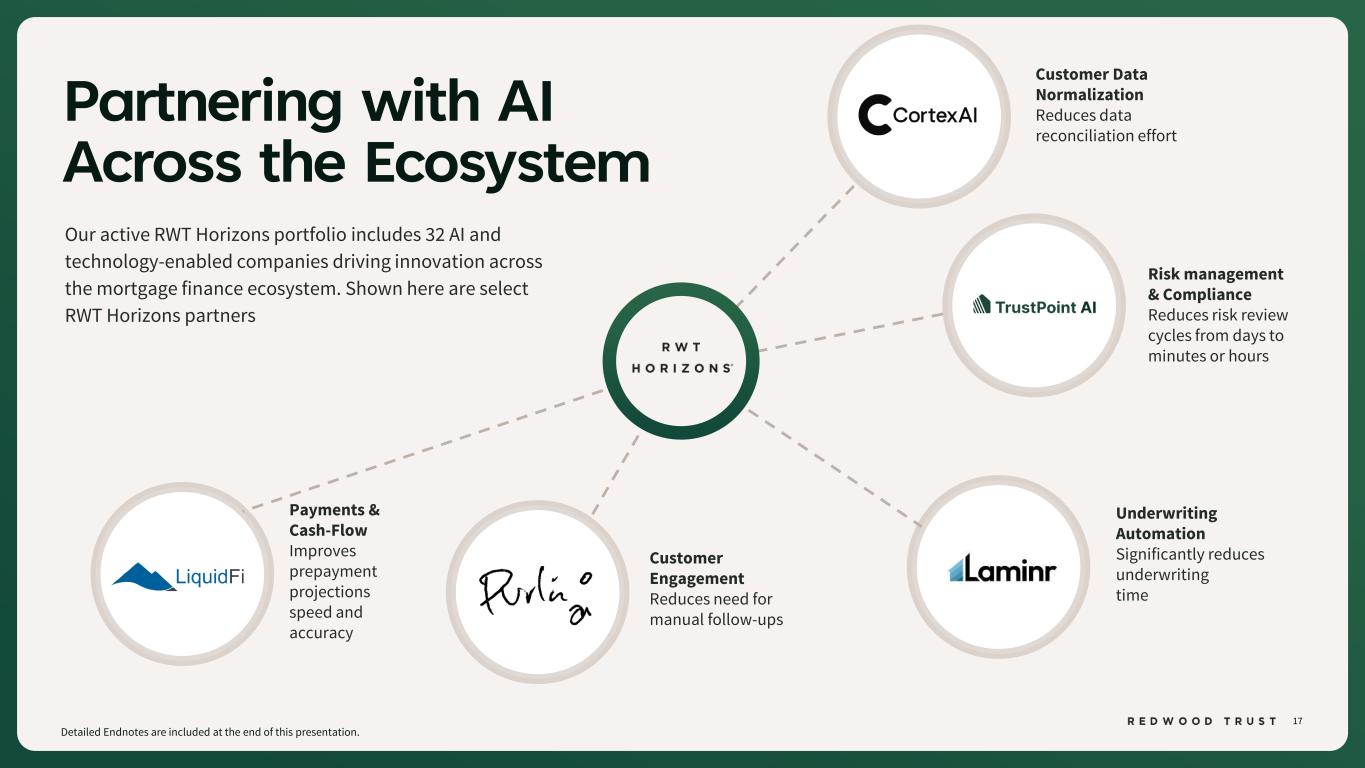
17 Partnering with AI Across the Ecosystem Payments & Cash-Flow Improves prepayment projections speed and accuracy Customer Engagement Reduces need for manual follow-ups Underwriting Automation Significantly reduces underwriting time Customer Data Normalization Reduces data reconciliation effort Risk management & Compliance Reduces risk review cycles from days to minutes or hours Our active RWT Horizons portfolio includes 32 AI and technology-enabled companies driving innovation across the mortgage finance ecosystem. Shown here are select RWT Horizons partners Detailed Endnotes are included at the end of this presentation.

First Quarter 2026 Earnings & Segment Results
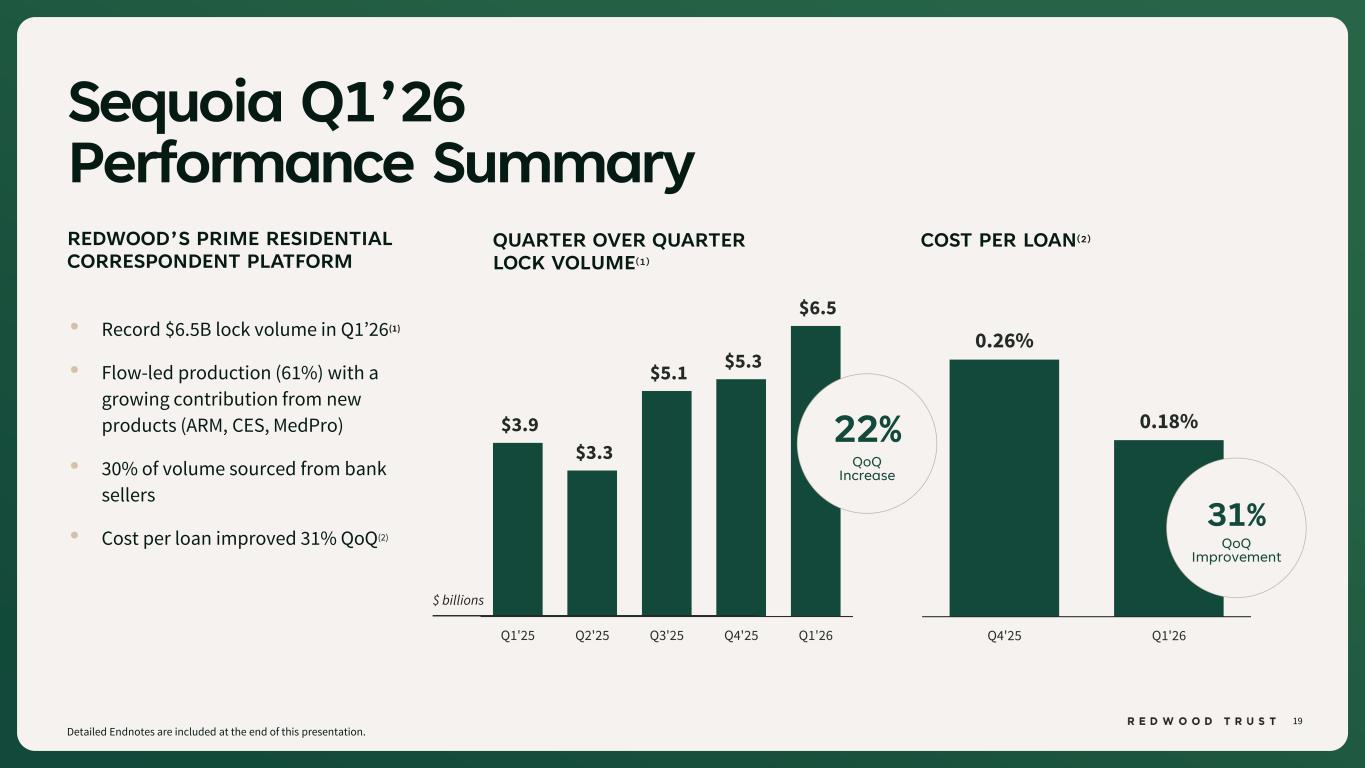
19 $3.9 $3.3 $5.1 $5.3 $6.5 Q1'25 Q2'25 Q3'25 Q4'25 Q1'26 Sequoia Q1’26 Performance Summary Detailed Endnotes are included at the end of this presentation. • Record $6.5B lock volume in Q1’26(1) • Flow-led production (61%) with a growing contribution from new products (ARM, CES, MedPro) • 30% of volume sourced from bank sellers • Cost per loan improved 31% QoQ(2) QUARTER OVER QUARTER LOCK VOLUME(1) REDWOOD’S PRIME RESIDENTIAL CORRESPONDENT PLATFORM 22% QoQ Increase COST PER LOAN(2) $ billions 0.26% 0.18% Q4'25 Q1'26 31% QoQ Improvement
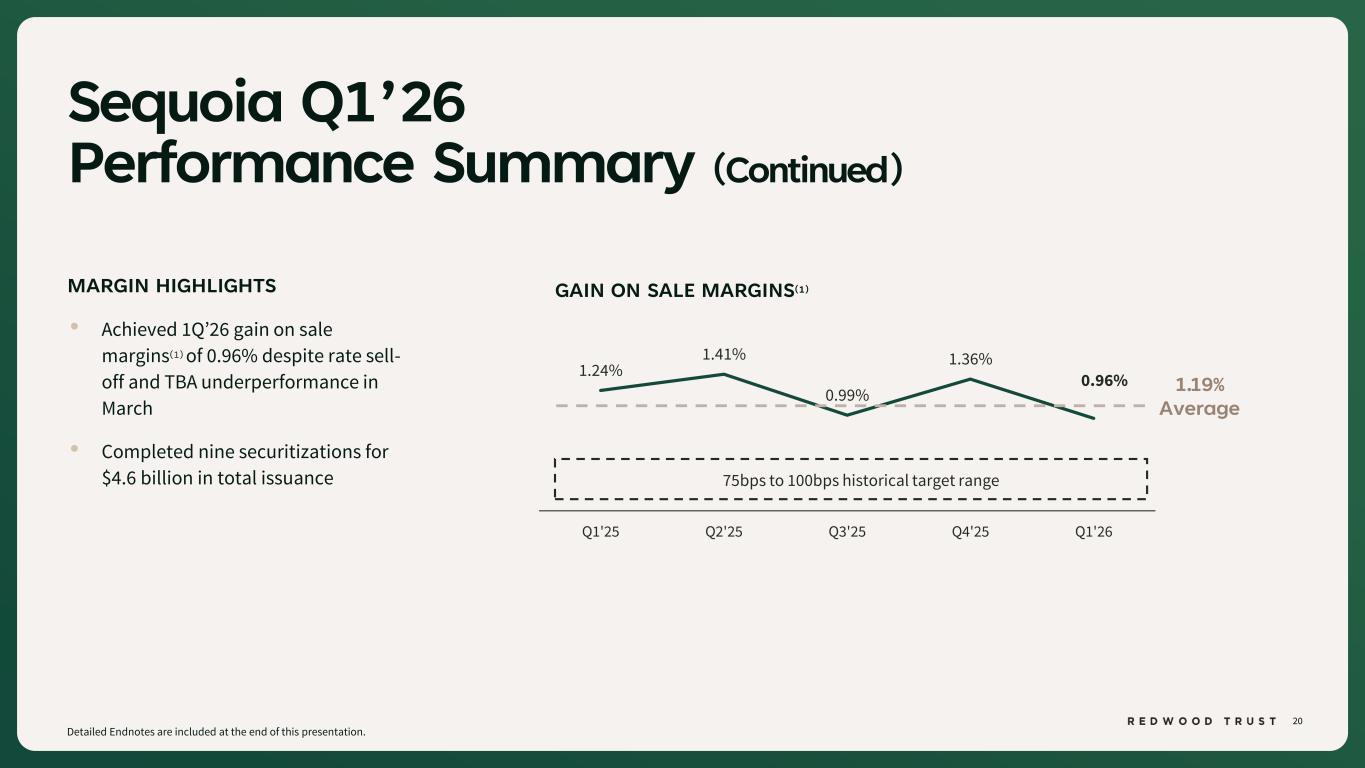
20 1.24% 1.41% 0.99% 1.36% 0.96% Q1'25 Q2'25 Q3'25 Q4'25 Q1'26 Sequoia Q1’26 Performance Summary (Continued) Detailed Endnotes are included at the end of this presentation. GAIN ON SALE MARGINS(1) 1.19% Average 75bps to 100bps historical target range • Achieved 1Q’26 gain on sale margins(1) of 0.96% despite rate sell- off and TBA underperformance in March • Completed nine securitizations for $4.6 billion in total issuance MARGIN HIGHLIGHTS
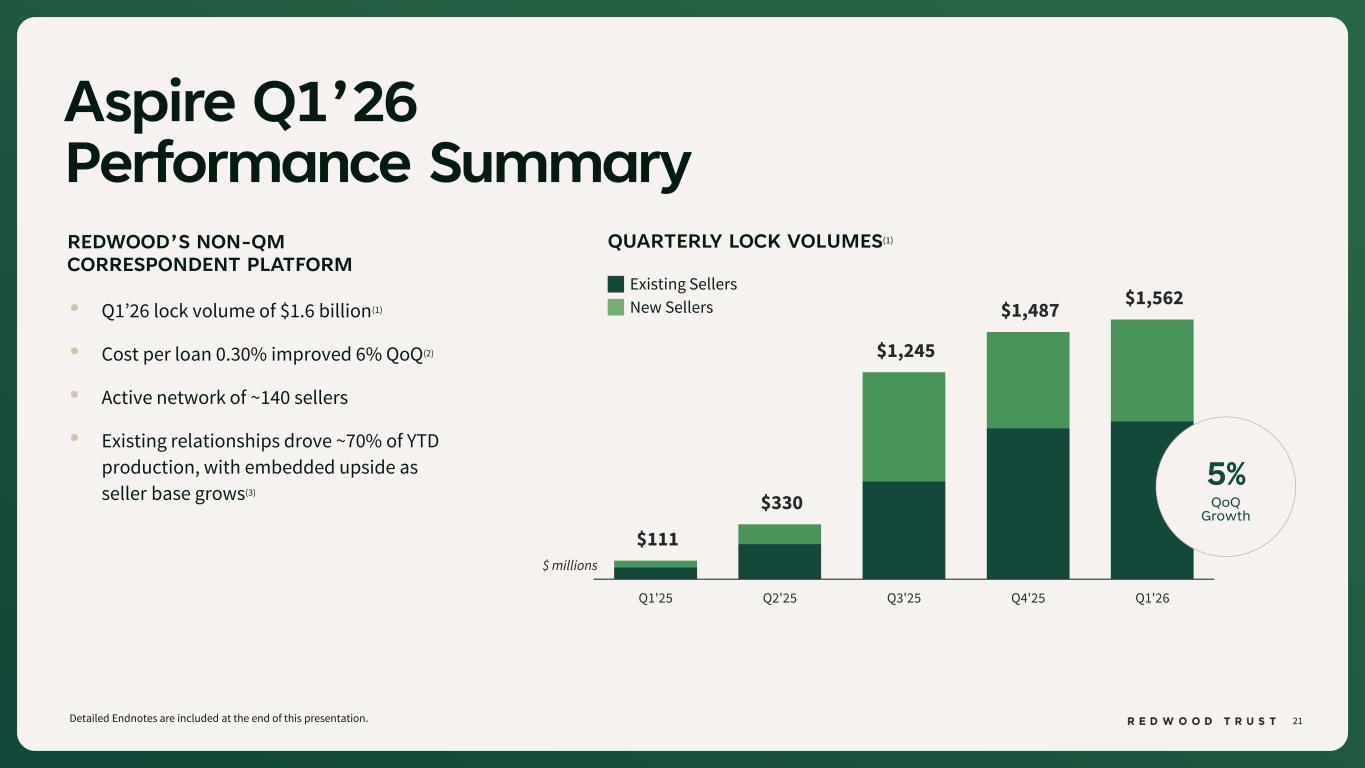
21 $111 $330 $1,245 $1,487 $1,562 Q1'25 Q2'25 Q3'25 Q4'25 Q1'26 Aspire Q1’26 Performance Summary Detailed Endnotes are included at the end of this presentation. • Q1’26 lock volume of $1.6 billion(1) • Cost per loan 0.30% improved 6% QoQ(2) • Active network of ~140 sellers • Existing relationships drove ~70% of YTD production, with embedded upside as seller base grows(3) QUARTERLY LOCK VOLUMES(1)REDWOOD’S NON-QM CORRESPONDENT PLATFORM $ millions Existing Sellers New Sellers 5% QoQ Growth
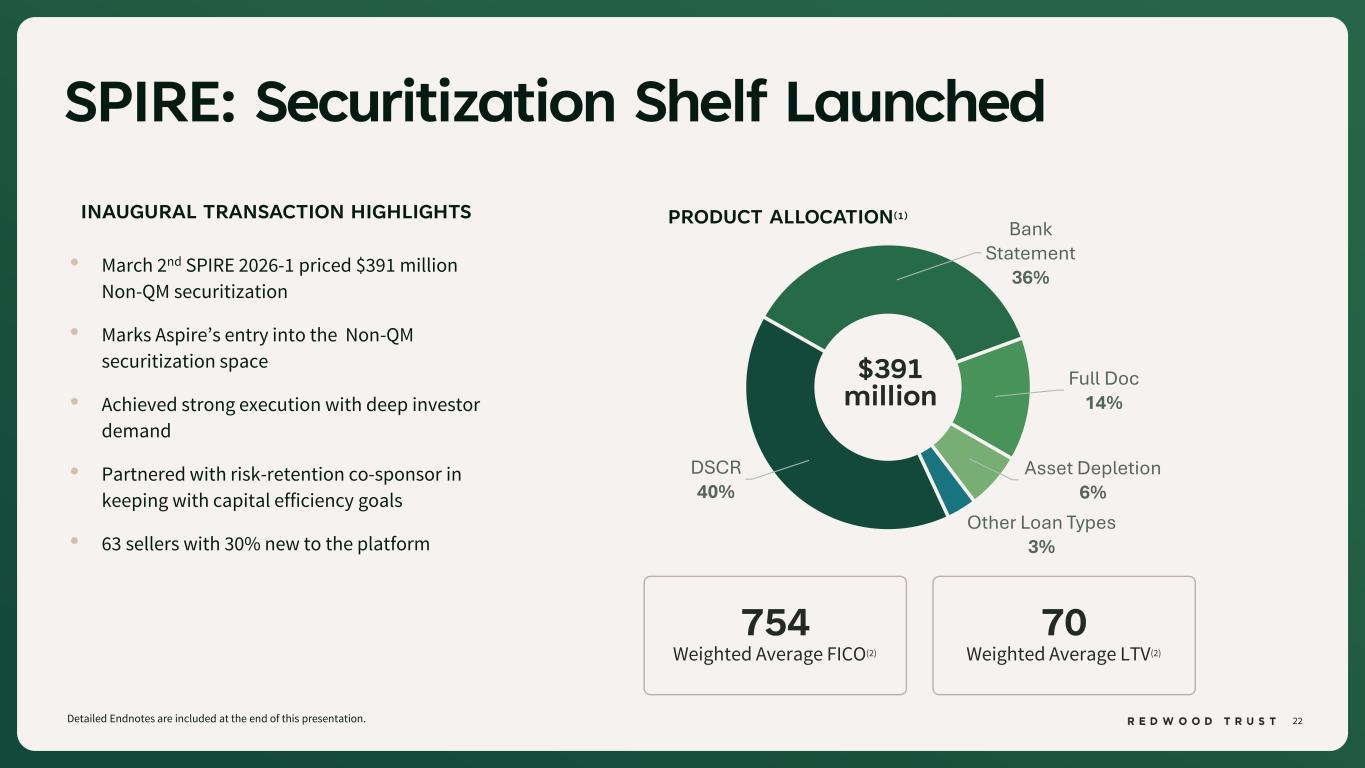
22 SPIRE: Securitization Shelf Launched Detailed Endnotes are included at the end of this presentation. • March 2nd SPIRE 2026-1 priced $391 million Non-QM securitization • Marks Aspire’s entry into the Non-QM securitization space • Achieved strong execution with deep investor demand • Partnered with risk-retention co-sponsor in keeping with capital efficiency goals • 63 sellers with 30% new to the platform INAUGURAL TRANSACTION HIGHLIGHTS DSCR 40% Bank Statement 36% Full Doc 14% Asset Depletion 6% Other Loan Types 3% $391 million PRODUCT ALLOCATION(1) 754 Weighted Average FICO(2) 70 Weighted Average LTV(2)
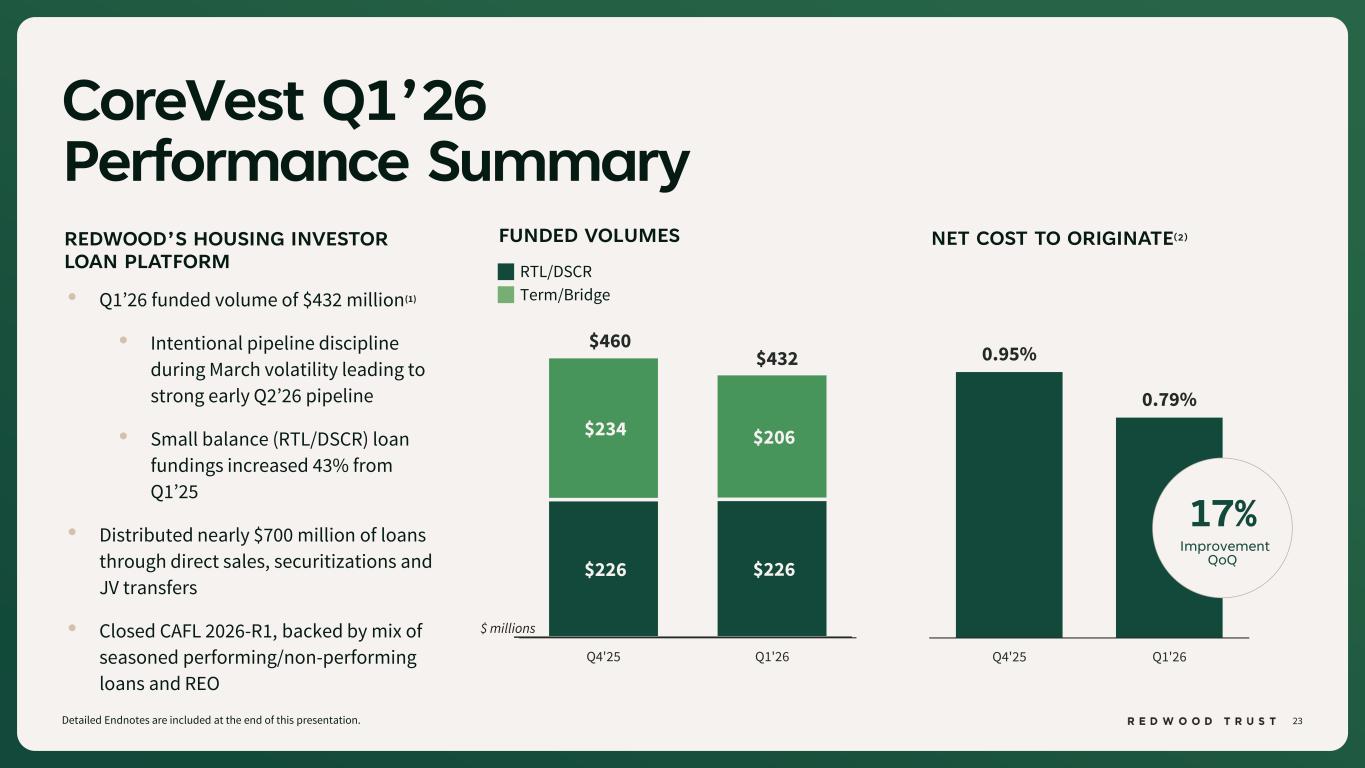
23 0.95% 0.79% Q4'25 Q1'26 CoreVest Q1’26 Performance Summary Detailed Endnotes are included at the end of this presentation. • Q1’26 funded volume of $432 million(1) • Intentional pipeline discipline during March volatility leading to strong early Q2’26 pipeline • Small balance (RTL/DSCR) loan fundings increased 43% from Q1’25 • Distributed nearly $700 million of loans through direct sales, securitizations and JV transfers • Closed CAFL 2026-R1, backed by mix of seasoned performing/non-performing loans and REO REDWOOD’S HOUSING INVESTOR LOAN PLATFORM FUNDED VOLUMES NET COST TO ORIGINATE(2) $226 $226 $234 $206 Q4'25 Q1'26 $ millions $460 $432 17% Improvement QoQ RTL/DSCR Term/Bridge
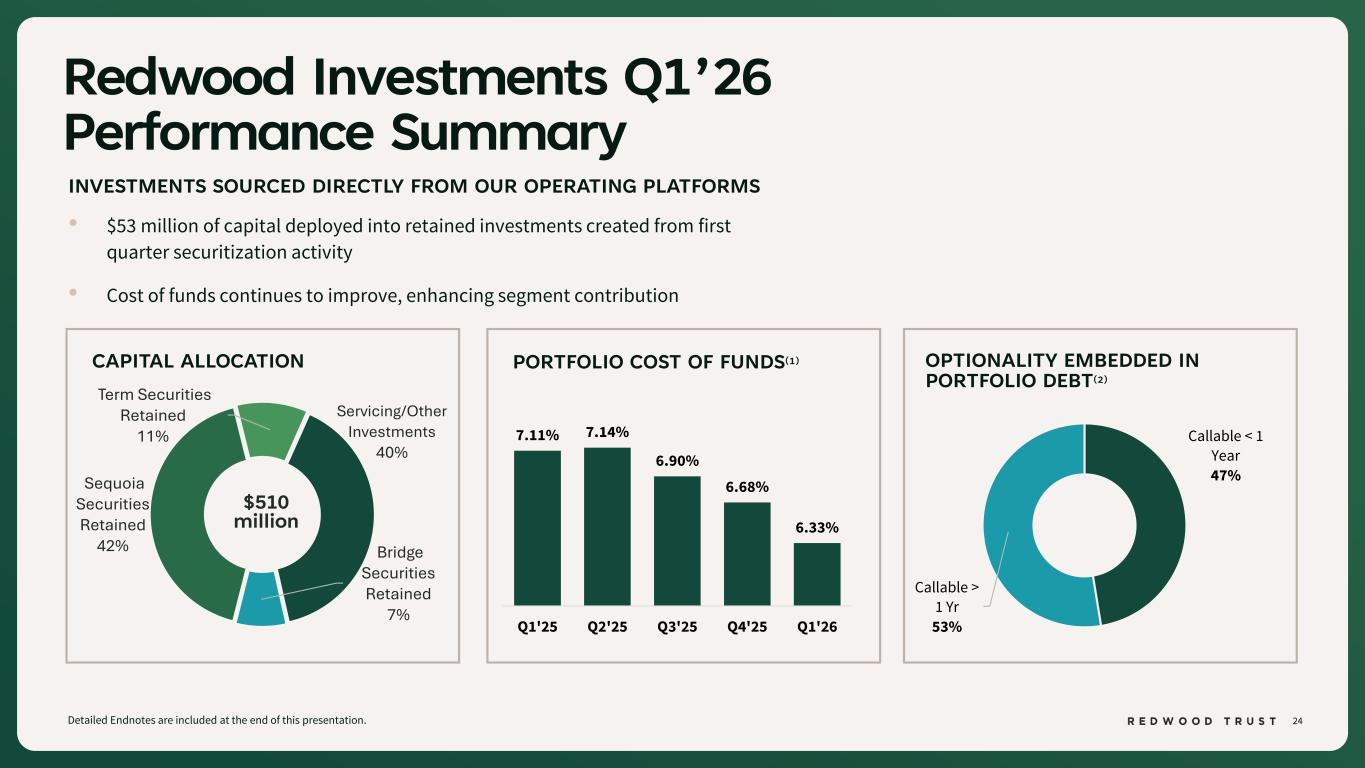
24 Servicing/Other Investments 40% Bridge Securities Retained 7% Sequoia Securities Retained 42% Term Securities Retained 11% Redwood Investments Q1’26 Performance Summary INVESTMENTS SOURCED DIRECTLY FROM OUR OPERATING PLATFORMS • $53 million of capital deployed into retained investments created from first quarter securitization activity • Cost of funds continues to improve, enhancing segment contribution CAPITAL ALLOCATION Detailed Endnotes are included at the end of this presentation. $510 million OPTIONALITY EMBEDDED IN PORTFOLIO DEBT(2) PORTFOLIO COST OF FUNDS(1) 7.11% 7.14% 6.90% 6.68% 6.33% Q1'25 Q2'25 Q3'25 Q4'25 Q1'26 Callable < 1 Year 47% Callable > 1 Yr 53%
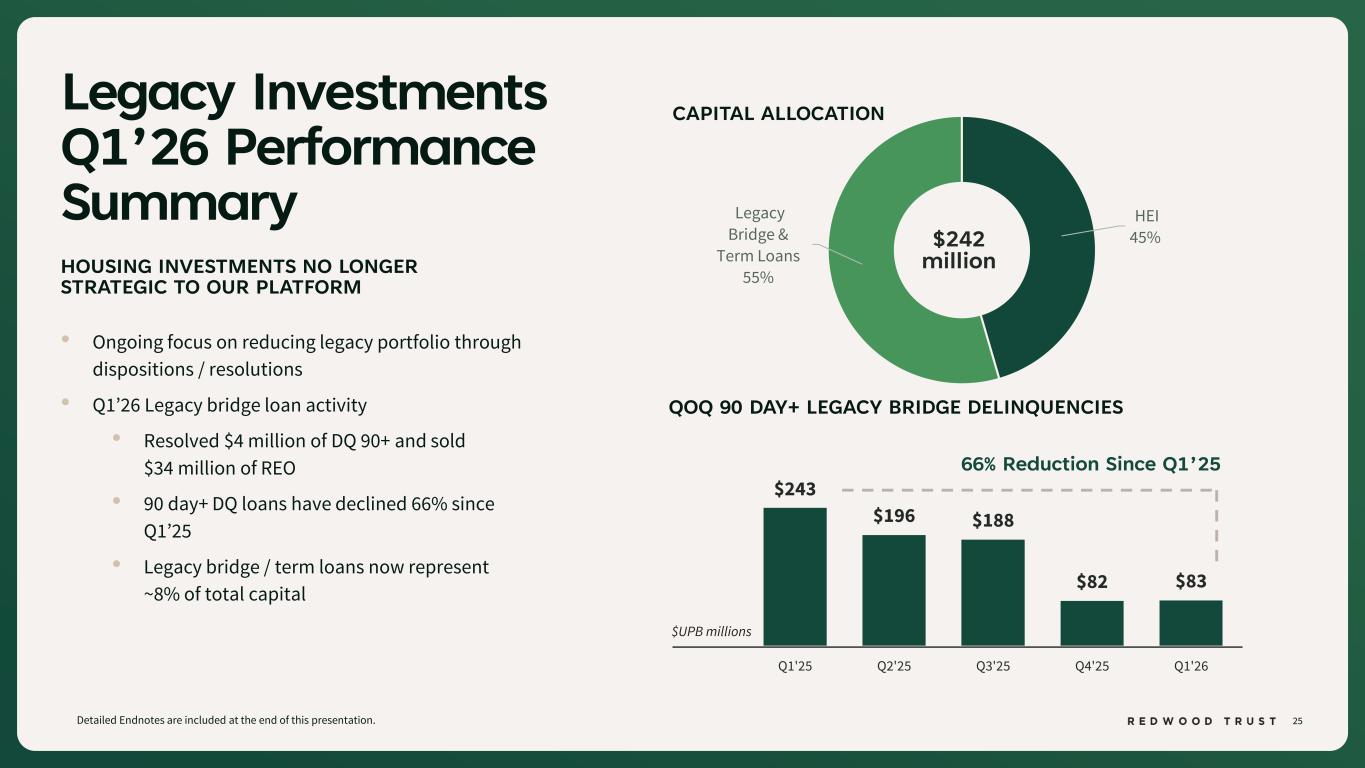
25 Legacy Investments Q1’26 Performance Summary QOQ 90 DAY+ LEGACY BRIDGE DELINQUENCIES $243 $196 $188 $82 $83 Q1'25 Q2'25 Q3'25 Q4'25 Q1'26 66% Reduction Since Q1’25 CAPITAL ALLOCATION Detailed Endnotes are included at the end of this presentation. $242 millionHOUSING INVESTMENTS NO LONGER STRATEGIC TO OUR PLATFORM • Ongoing focus on reducing legacy portfolio through dispositions / resolutions • Q1’26 Legacy bridge loan activity • Resolved $4 million of DQ 90+ and sold $34 million of REO • 90 day+ DQ loans have declined 66% since Q1’25 • Legacy bridge / term loans now represent ~8% of total capital $UPB millions HEI 45% Legacy Bridge & Term Loans 55%

Financial Results
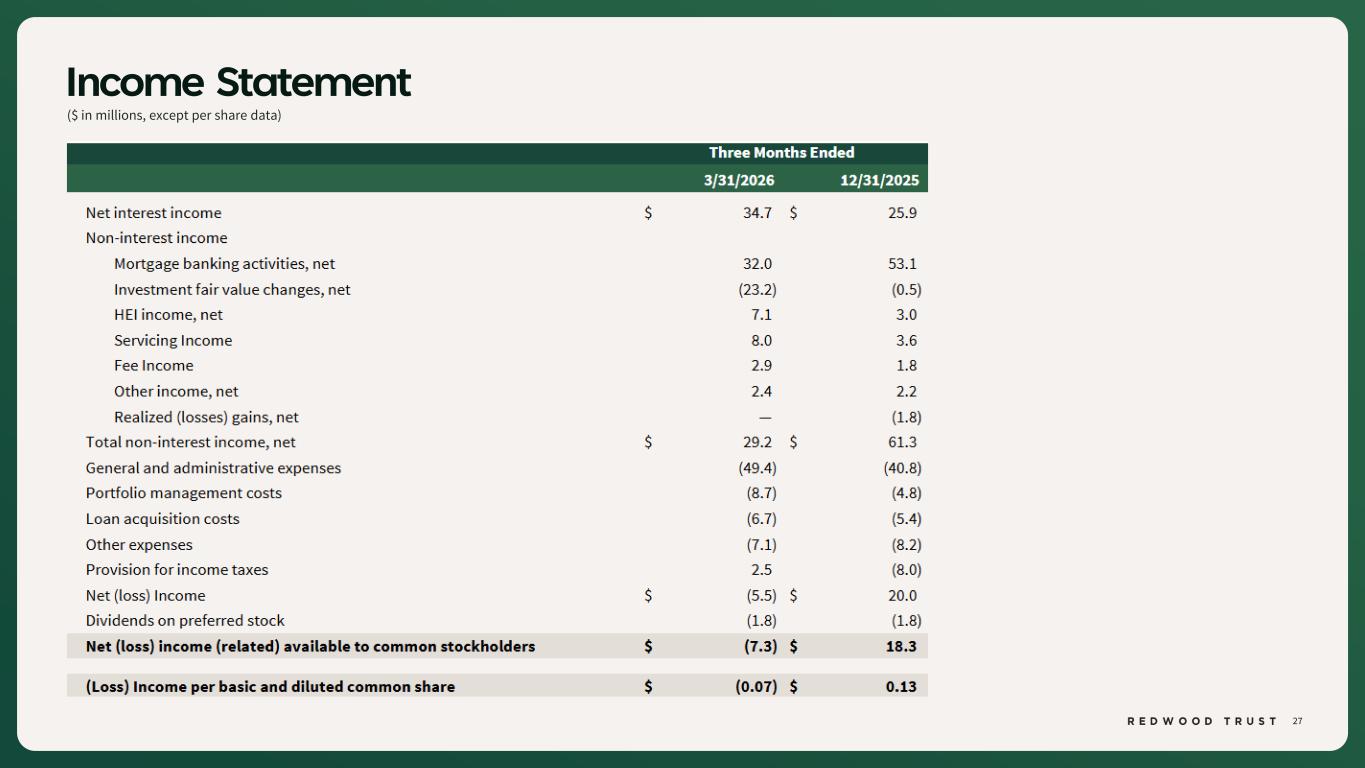
27 Income Statement ($ in millions, except per share data)
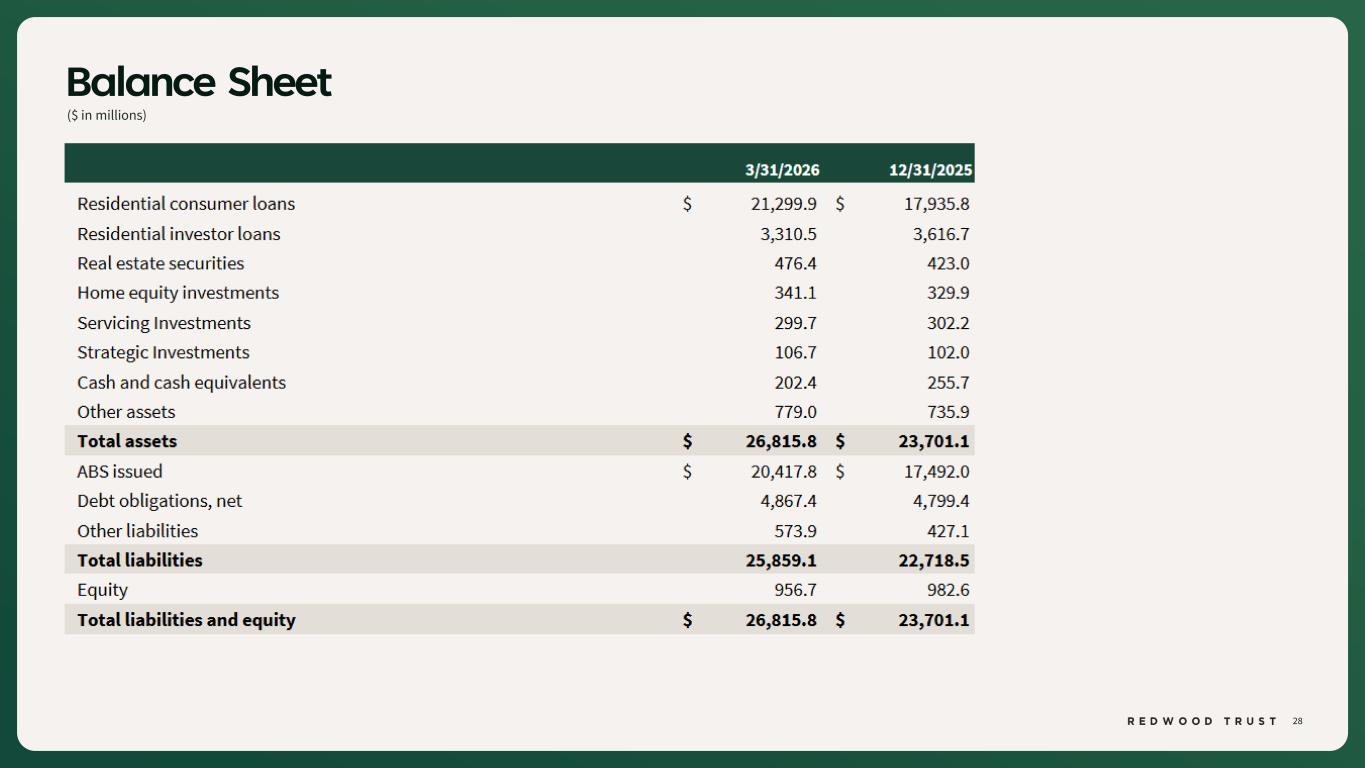
28 Balance Sheet ($ in millions)
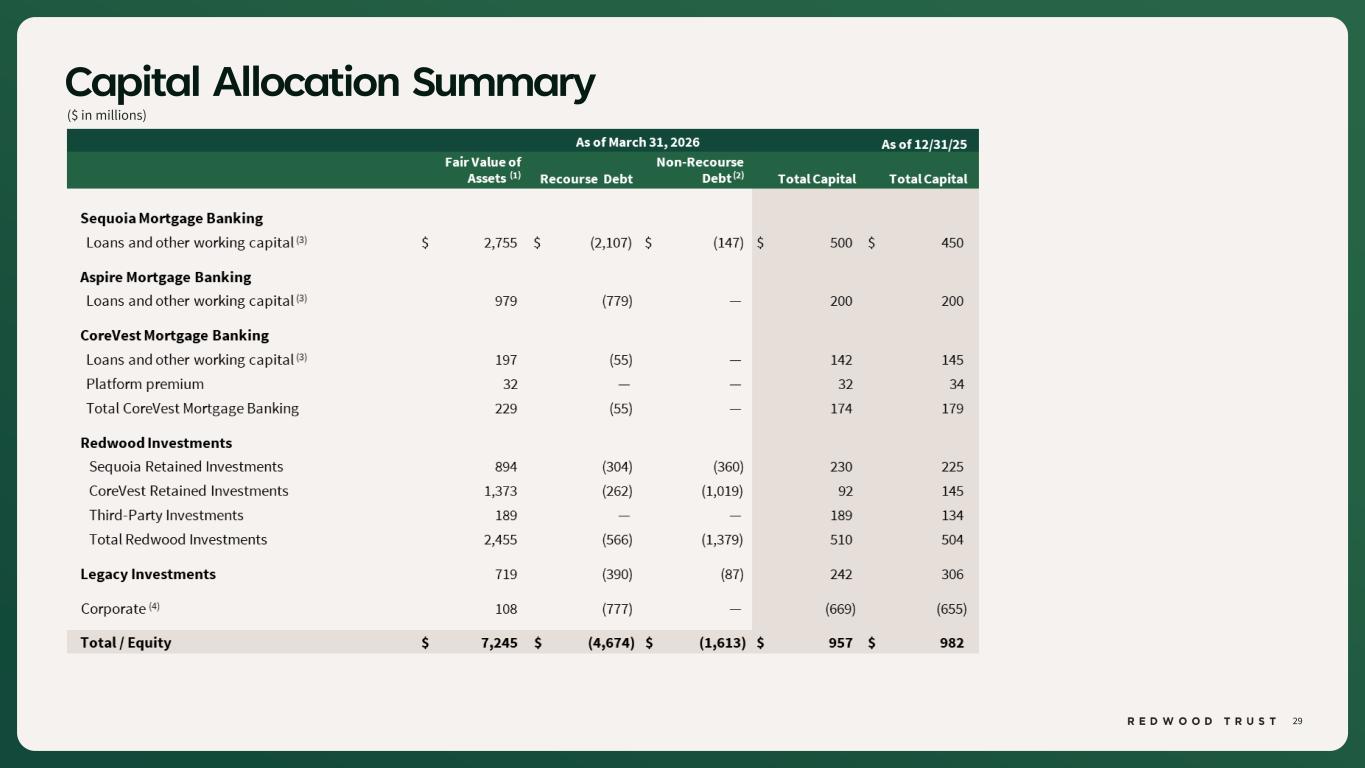
29 Capital Allocation Summary ($ in millions)
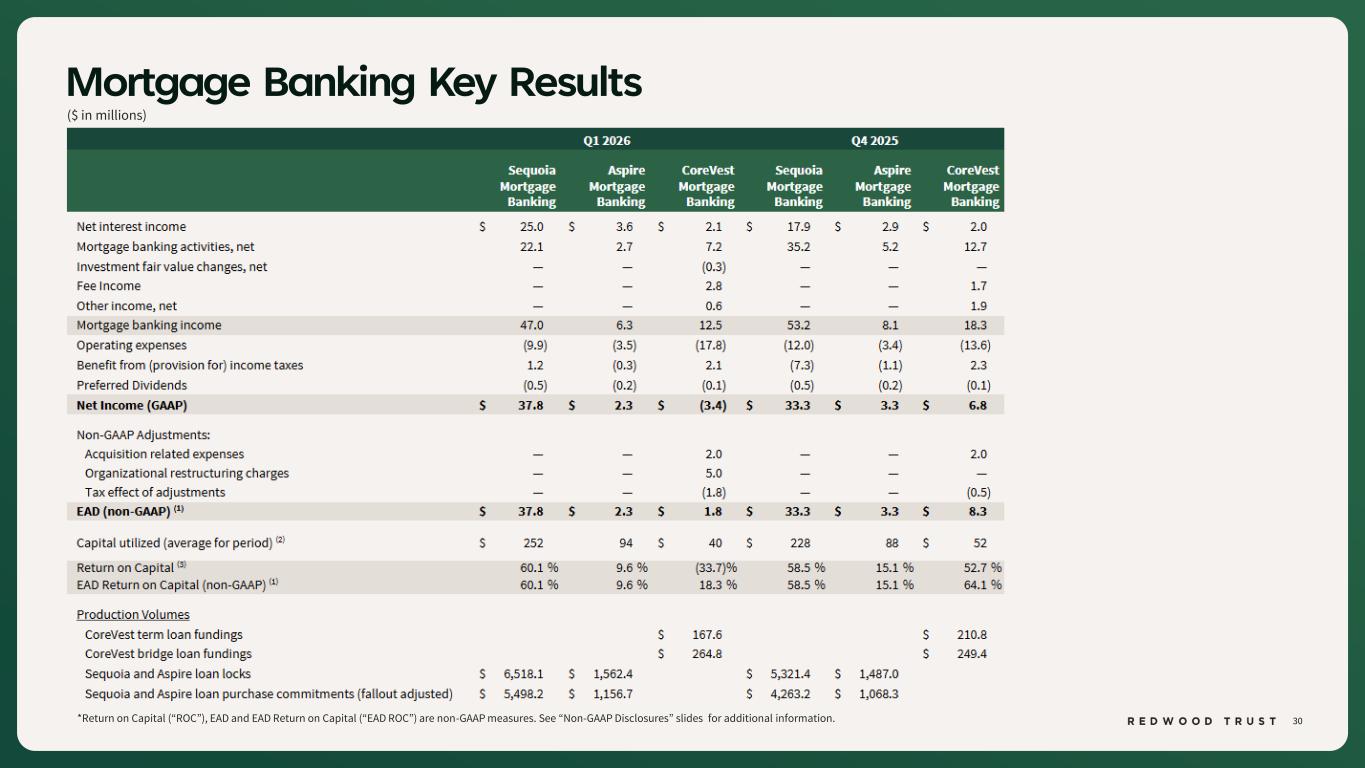
30 Mortgage Banking Key Results ($ in millions) *Return on Capital (“ROC”), EAD and EAD Return on Capital (“EAD ROC”) are non-GAAP measures. See “Non-GAAP Disclosures” slides for additional information.
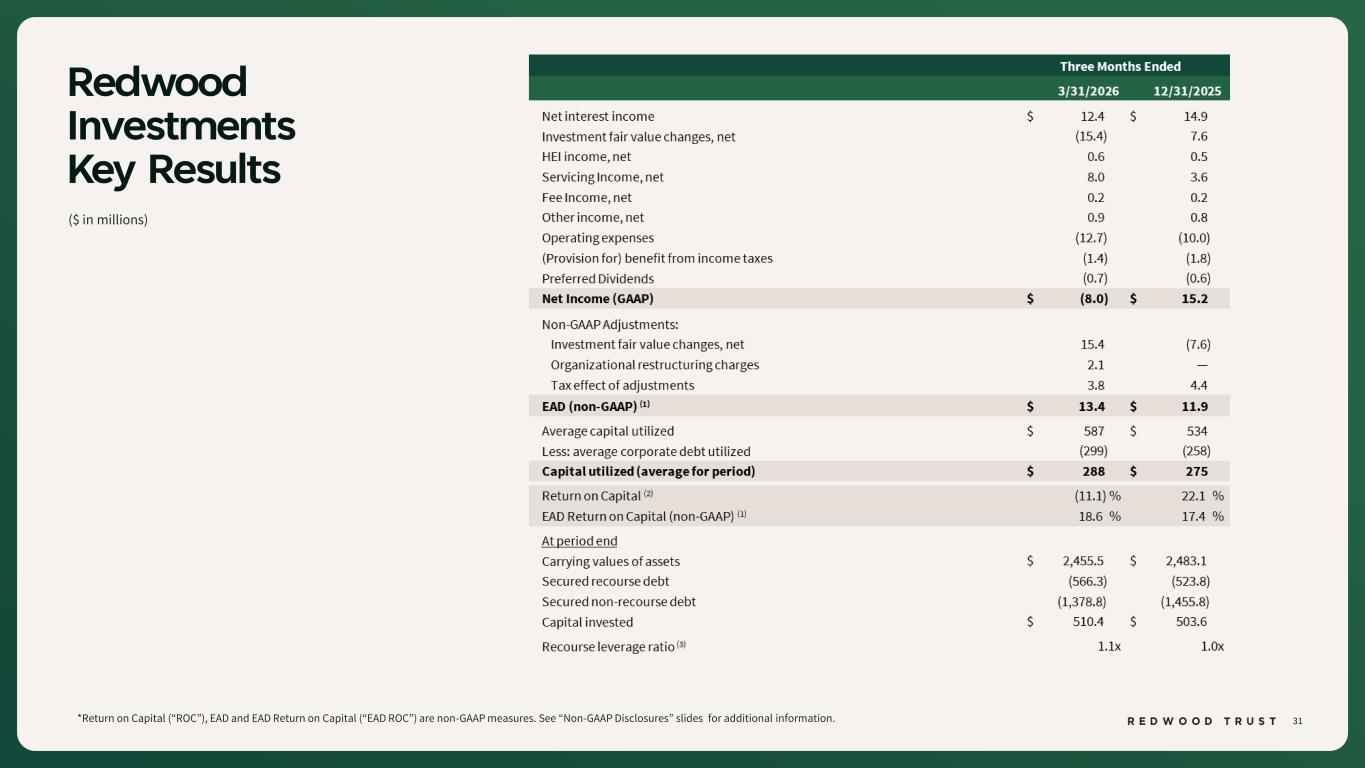
31 Redwood Investments Key Results ($ in millions) *Return on Capital (“ROC”), EAD and EAD Return on Capital (“EAD ROC”) are non-GAAP measures. See “Non-GAAP Disclosures” slides for additional information.
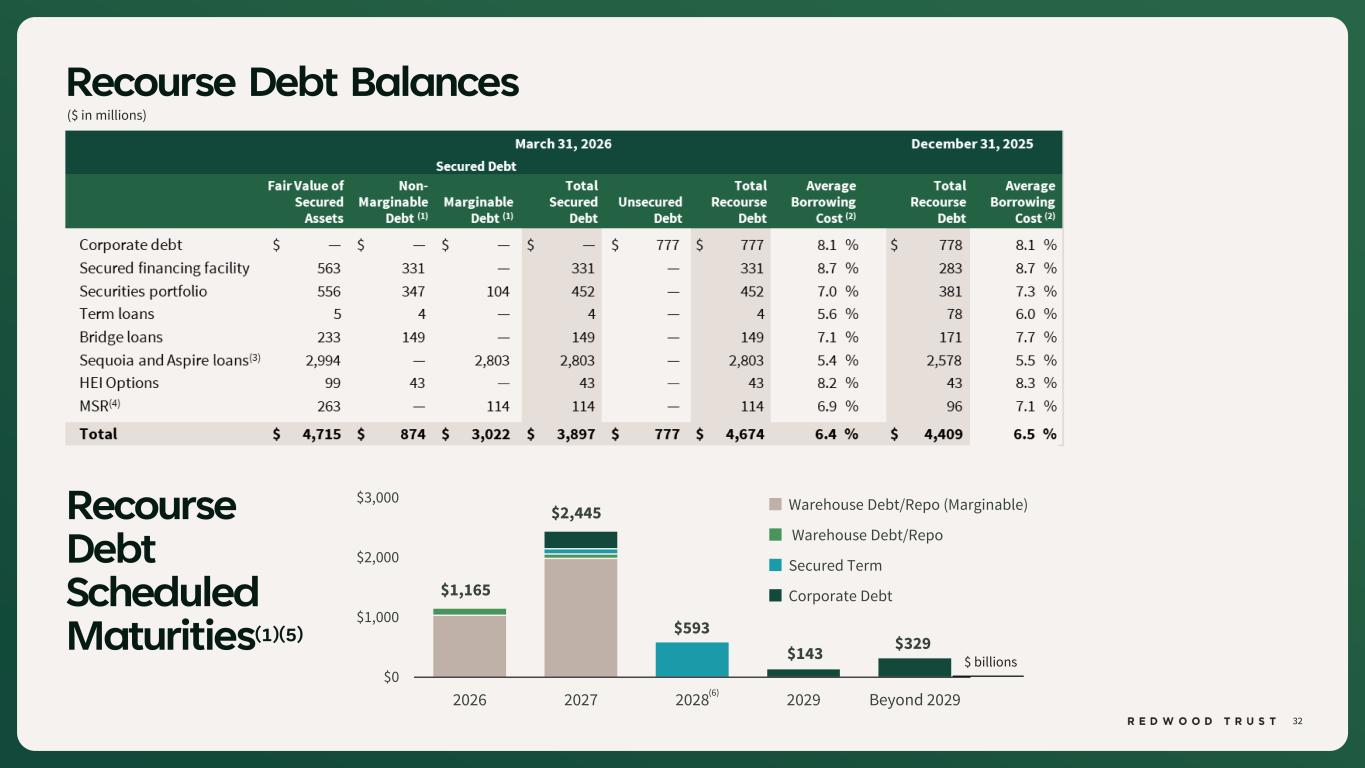
32 Recourse Debt Scheduled Maturities(1)(5) Recourse Debt Balances ($ in millions) $1,165 $593 $143 $329 $2,445 $ billions $0 $1,000 $2,000 $3,000 2026 2027 2028 2029 Beyond 2029 Warehouse Debt/Repo (Marginable) Warehouse Debt/Repo Secured Term Corporate Debt (6)

Non-GAAP Disclosures
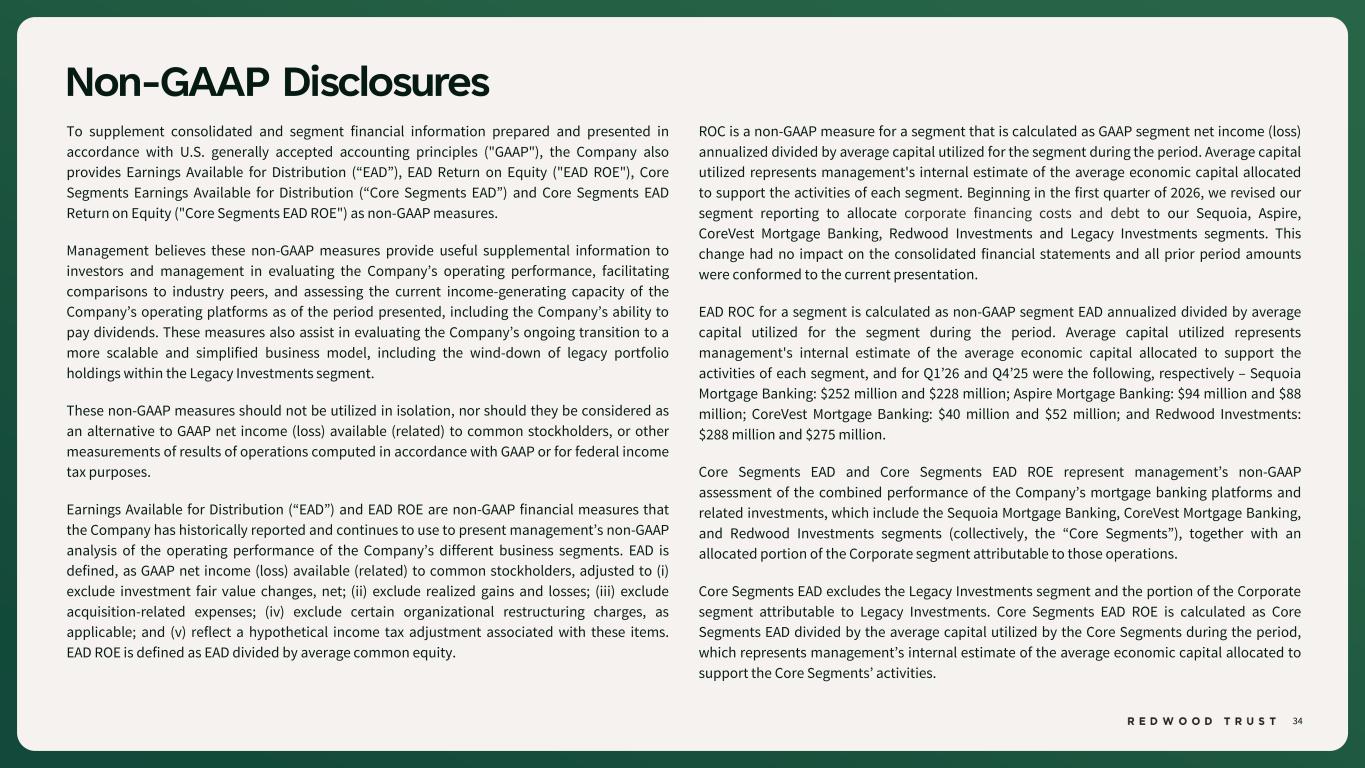
34 Non-GAAP Disclosures To supplement consolidated and segment financial information prepared and presented in accordance with U.S. generally accepted accounting principles ("GAAP"), the Company also provides Earnings Available for Distribution (“EAD”), EAD Return on Equity ("EAD ROE"), Core Segments Earnings Available for Distribution (“Core Segments EAD”) and Core Segments EAD Return on Equity ("Core Segments EAD ROE") as non-GAAP measures. Management believes these non-GAAP measures provide useful supplemental information to investors and management in evaluating the Company’s operating performance, facilitating comparisons to industry peers, and assessing the current income-generating capacity of the Company’s operating platforms as of the period presented, including the Company’s ability to pay dividends. These measures also assist in evaluating the Company’s ongoing transition to a more scalable and simplified business model, including the wind-down of legacy portfolio holdings within the Legacy Investments segment. These non-GAAP measures should not be utilized in isolation, nor should they be considered as an alternative to GAAP net income (loss) available (related) to common stockholders, or other measurements of results of operations computed in accordance with GAAP or for federal income tax purposes. Earnings Available for Distribution (“EAD”) and EAD ROE are non-GAAP financial measures that the Company has historically reported and continues to use to present management’s non-GAAP analysis of the operating performance of the Company’s different business segments. EAD is defined, as GAAP net income (loss) available (related) to common stockholders, adjusted to (i) exclude investment fair value changes, net; (ii) exclude realized gains and losses; (iii) exclude acquisition-related expenses; (iv) exclude certain organizational restructuring charges, as applicable; and (v) reflect a hypothetical income tax adjustment associated with these items. EAD ROE is defined as EAD divided by average common equity. ROC is a non-GAAP measure for a segment that is calculated as GAAP segment net income (loss) annualized divided by average capital utilized for the segment during the period. Average capital utilized represents management's internal estimate of the average economic capital allocated to support the activities of each segment. Beginning in the first quarter of 2026, we revised our segment reporting to allocate corporate financing costs and debt to our Sequoia, Aspire, CoreVest Mortgage Banking, Redwood Investments and Legacy Investments segments. This change had no impact on the consolidated financial statements and all prior period amounts were conformed to the current presentation. EAD ROC for a segment is calculated as non-GAAP segment EAD annualized divided by average capital utilized for the segment during the period. Average capital utilized represents management's internal estimate of the average economic capital allocated to support the activities of each segment, and for Q1’26 and Q4’25 were the following, respectively – Sequoia Mortgage Banking: $252 million and $228 million; Aspire Mortgage Banking: $94 million and $88 million; CoreVest Mortgage Banking: $40 million and $52 million; and Redwood Investments: $288 million and $275 million. Core Segments EAD and Core Segments EAD ROE represent management’s non-GAAP assessment of the combined performance of the Company’s mortgage banking platforms and related investments, which include the Sequoia Mortgage Banking, CoreVest Mortgage Banking, and Redwood Investments segments (collectively, the “Core Segments”), together with an allocated portion of the Corporate segment attributable to those operations. Core Segments EAD excludes the Legacy Investments segment and the portion of the Corporate segment attributable to Legacy Investments. Core Segments EAD ROE is calculated as Core Segments EAD divided by the average capital utilized by the Core Segments during the period, which represents management’s internal estimate of the average economic capital allocated to support the Core Segments’ activities.
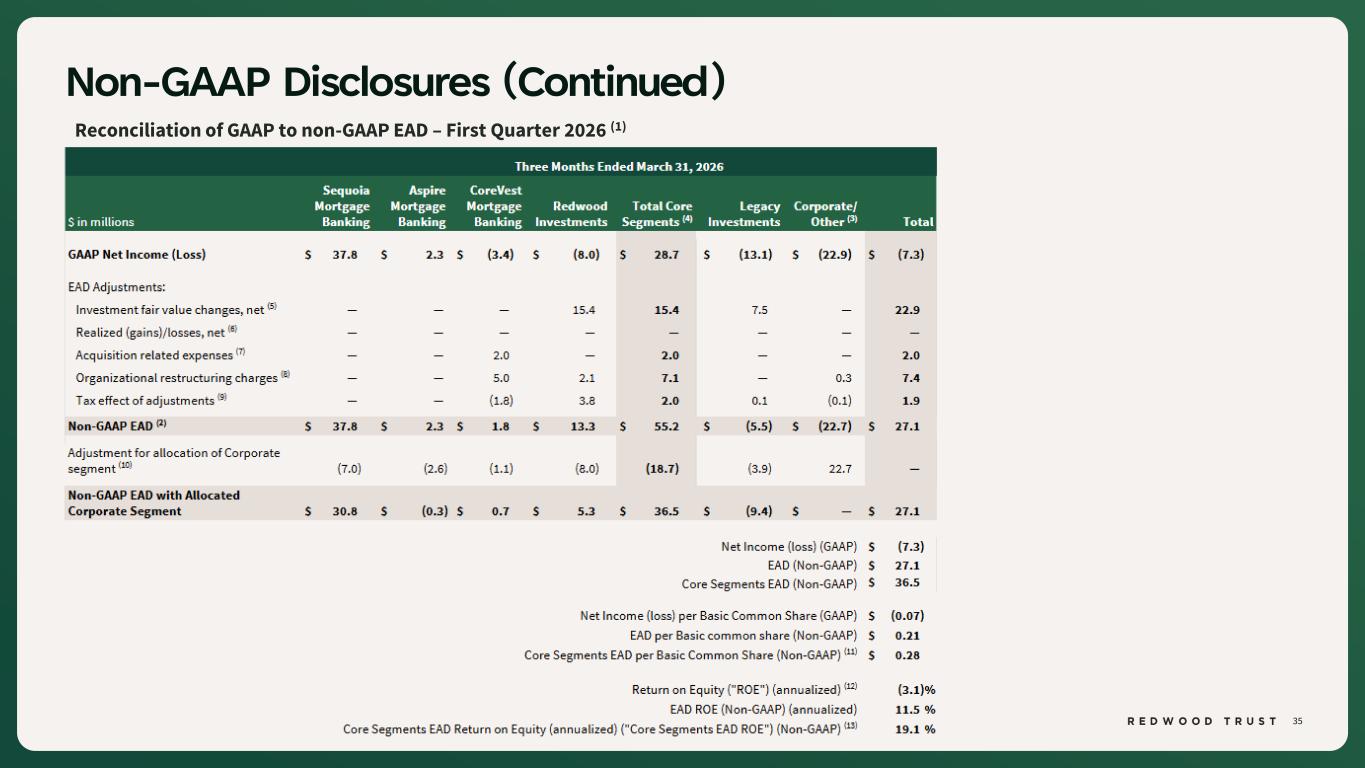
35 Non-GAAP Disclosures (Continued) Reconciliation of GAAP to non-GAAP EAD – First Quarter 2026 (1)
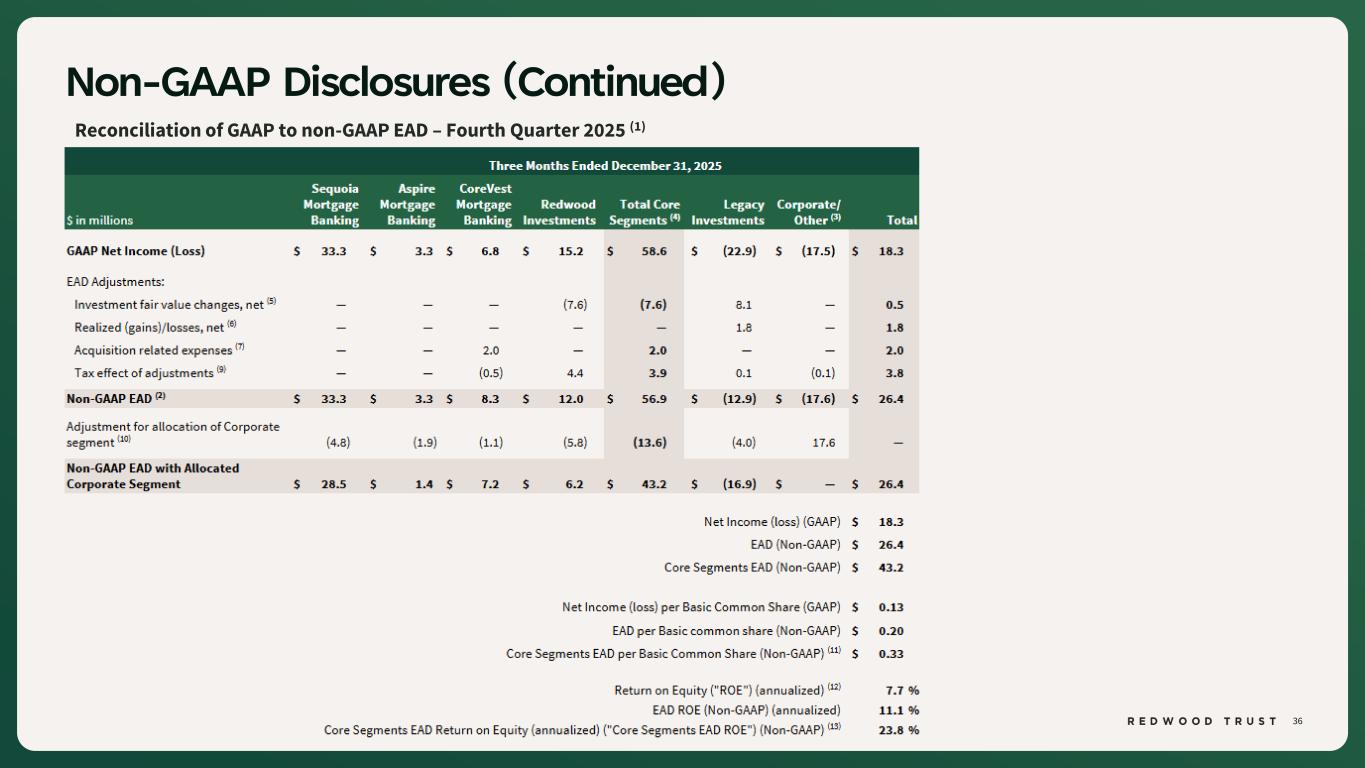
36 Non-GAAP Disclosures (Continued) Reconciliation of GAAP to non-GAAP EAD – Fourth Quarter 2025 (1)
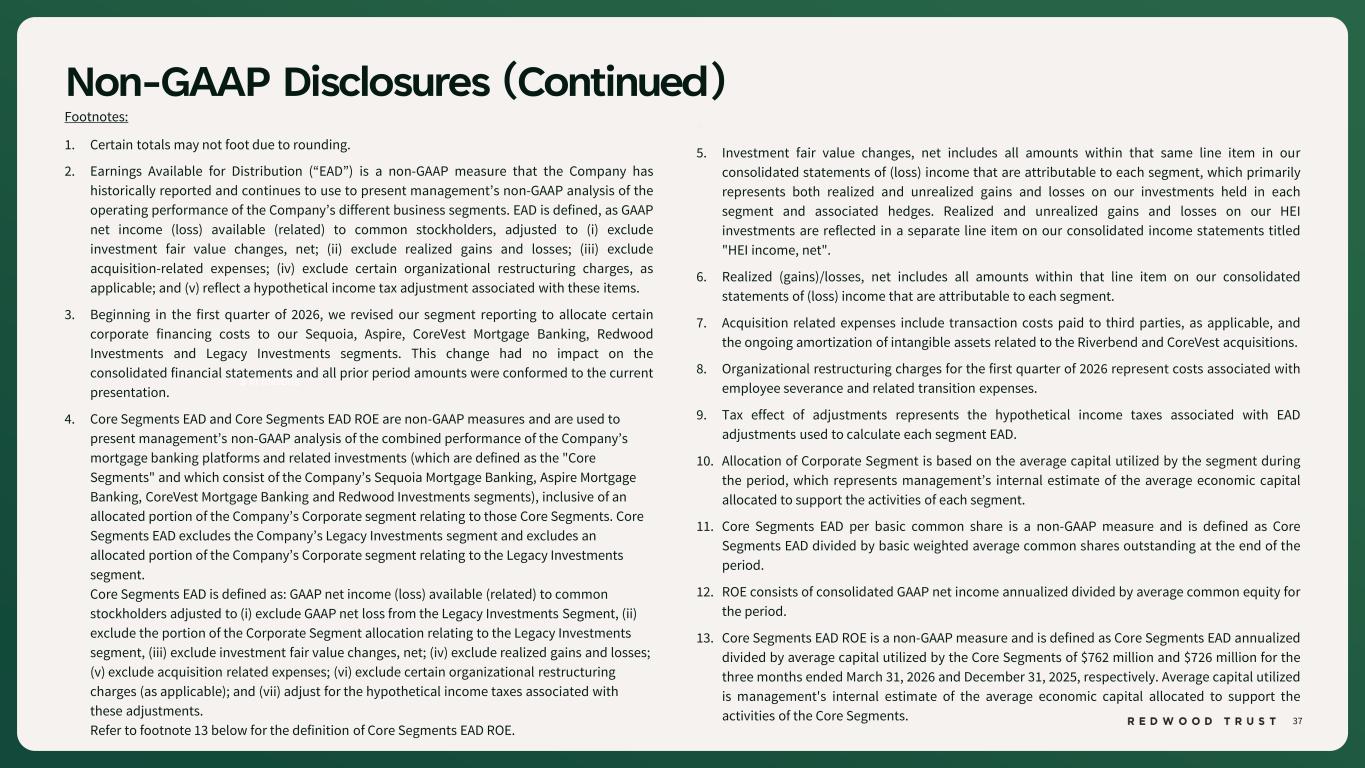
37 $ in millions Non-GAAP Disclosures (Continued) Footnotes: 1. Certain totals may not foot due to rounding. 2. Earnings Available for Distribution (“EAD”) is a non-GAAP measure that the Company has historically reported and continues to use to present management’s non-GAAP analysis of the operating performance of the Company’s different business segments. EAD is defined, as GAAP net income (loss) available (related) to common stockholders, adjusted to (i) exclude investment fair value changes, net; (ii) exclude realized gains and losses; (iii) exclude acquisition-related expenses; (iv) exclude certain organizational restructuring charges, as applicable; and (v) reflect a hypothetical income tax adjustment associated with these items. 3. Beginning in the first quarter of 2026, we revised our segment reporting to allocate certain corporate financing costs to our Sequoia, Aspire, CoreVest Mortgage Banking, Redwood Investments and Legacy Investments segments. This change had no impact on the consolidated financial statements and all prior period amounts were conformed to the current presentation. 4. Core Segments EAD and Core Segments EAD ROE are non-GAAP measures and are used to present management’s non-GAAP analysis of the combined performance of the Company’s mortgage banking platforms and related investments (which are defined as the "Core Segments" and which consist of the Company’s Sequoia Mortgage Banking, Aspire Mortgage Banking, CoreVest Mortgage Banking and Redwood Investments segments), inclusive of an allocated portion of the Company’s Corporate segment relating to those Core Segments. Core Segments EAD excludes the Company’s Legacy Investments segment and excludes an allocated portion of the Company’s Corporate segment relating to the Legacy Investments segment. Core Segments EAD is defined as: GAAP net income (loss) available (related) to common stockholders adjusted to (i) exclude GAAP net loss from the Legacy Investments Segment, (ii) exclude the portion of the Corporate Segment allocation relating to the Legacy Investments segment, (iii) exclude investment fair value changes, net; (iv) exclude realized gains and losses; (v) exclude acquisition related expenses; (vi) exclude certain organizational restructuring charges (as applicable); and (vii) adjust for the hypothetical income taxes associated with these adjustments. Refer to footnote 13 below for the definition of Core Segments EAD ROE. 4. . 5. Investment fair value changes, net includes all amounts within that same line item in our consolidated statements of (loss) income that are attributable to each segment, which primarily represents both realized and unrealized gains and losses on our investments held in each segment and associated hedges. Realized and unrealized gains and losses on our HEI investments are reflected in a separate line item on our consolidated income statements titled "HEI income, net". 6. Realized (gains)/losses, net includes all amounts within that line item on our consolidated statements of (loss) income that are attributable to each segment. 7. Acquisition related expenses include transaction costs paid to third parties, as applicable, and the ongoing amortization of intangible assets related to the Riverbend and CoreVest acquisitions. 8. Organizational restructuring charges for the first quarter of 2026 represent costs associated with employee severance and related transition expenses. 9. Tax effect of adjustments represents the hypothetical income taxes associated with EAD adjustments used to calculate each segment EAD. 10. Allocation of Corporate Segment is based on the average capital utilized by the segment during the period, which represents management’s internal estimate of the average economic capital allocated to support the activities of each segment. 11. Core Segments EAD per basic common share is a non-GAAP measure and is defined as Core Segments EAD divided by basic weighted average common shares outstanding at the end of the period. 12. ROE consists of consolidated GAAP net income annualized divided by average common equity for the period. 13. Core Segments EAD ROE is a non-GAAP measure and is defined as Core Segments EAD annualized divided by average capital utilized by the Core Segments of $762 million and $726 million for the three months ended March 31, 2026 and December 31, 2025, respectively. Average capital utilized is management's internal estimate of the average economic capital allocated to support the activities of the Core Segments.

Endnotes
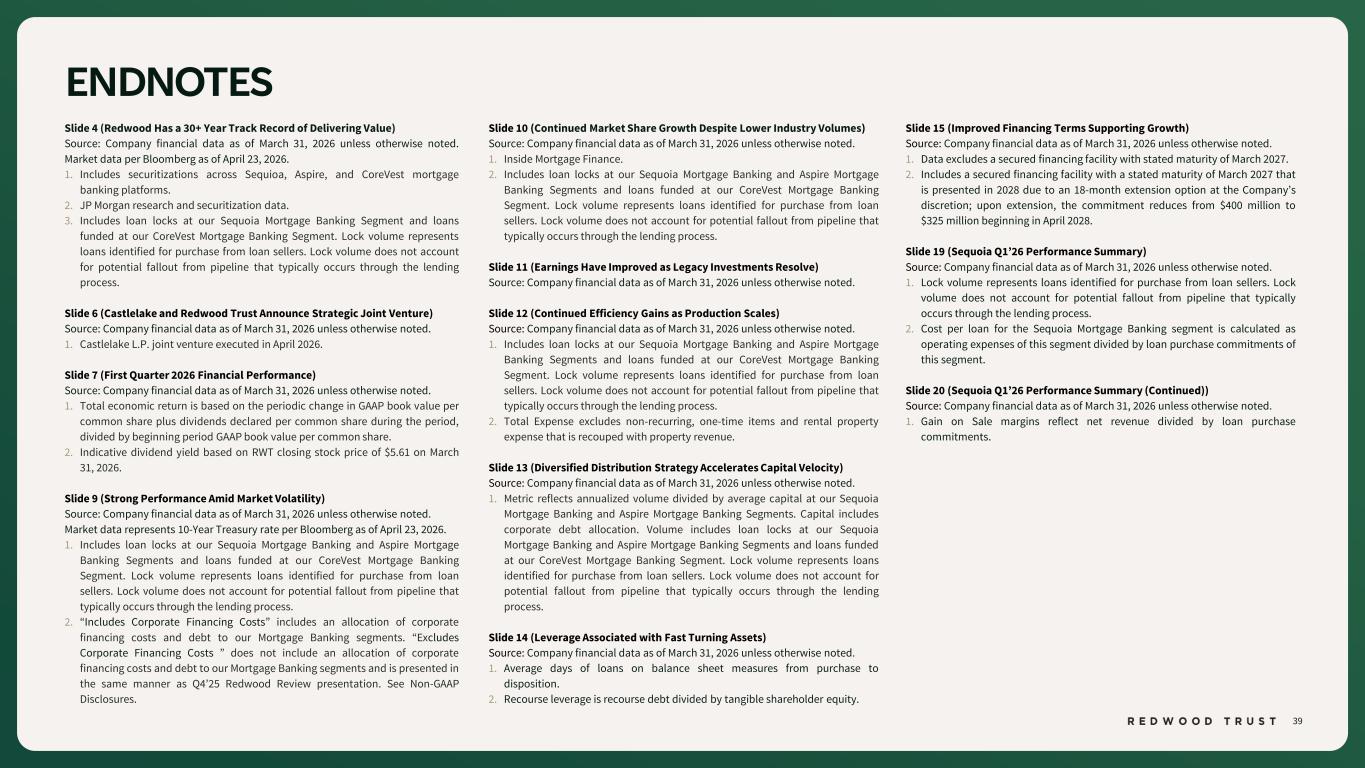
39 ENDNOTES Slide 4 (Redwood Has a 30+ Year Track Record of Delivering Value) Source: Company financial data as of March 31, 2026 unless otherwise noted. Market data per Bloomberg as of April 23, 2026. 1. Includes securitizations across Sequioa, Aspire, and CoreVest mortgage banking platforms. 2. JP Morgan research and securitization data. 3. Includes loan locks at our Sequoia Mortgage Banking Segment and loans funded at our CoreVest Mortgage Banking Segment. Lock volume represents loans identified for purchase from loan sellers. Lock volume does not account for potential fallout from pipeline that typically occurs through the lending process. Slide 6 (Castlelake and Redwood Trust Announce Strategic Joint Venture) Source: Company financial data as of March 31, 2026 unless otherwise noted. 1. Castlelake L.P. joint venture executed in April 2026. Slide 7 (First Quarter 2026 Financial Performance) Source: Company financial data as of March 31, 2026 unless otherwise noted. 1. Total economic return is based on the periodic change in GAAP book value per common share plus dividends declared per common share during the period, divided by beginning period GAAP book value per common share. 2. Indicative dividend yield based on RWT closing stock price of $5.61 on March 31, 2026. Slide 9 (Strong Performance Amid Market Volatility) Source: Company financial data as of March 31, 2026 unless otherwise noted. Market data represents 10-Year Treasury rate per Bloomberg as of April 23, 2026. 1. Includes loan locks at our Sequoia Mortgage Banking and Aspire Mortgage Banking Segments and loans funded at our CoreVest Mortgage Banking Segment. Lock volume represents loans identified for purchase from loan sellers. Lock volume does not account for potential fallout from pipeline that typically occurs through the lending process. 2. “Includes Corporate Financing Costs” includes an allocation of corporate financing costs and debt to our Mortgage Banking segments. “Excludes Corporate Financing Costs ” does not include an allocation of corporate financing costs and debt to our Mortgage Banking segments and is presented in the same manner as Q4’25 Redwood Review presentation. See Non-GAAP Disclosures. Slide 10 (Continued Market Share Growth Despite Lower Industry Volumes) Source: Company financial data as of March 31, 2026 unless otherwise noted. 1. Inside Mortgage Finance. 2. Includes loan locks at our Sequoia Mortgage Banking and Aspire Mortgage Banking Segments and loans funded at our CoreVest Mortgage Banking Segment. Lock volume represents loans identified for purchase from loan sellers. Lock volume does not account for potential fallout from pipeline that typically occurs through the lending process. Slide 11 (Earnings Have Improved as Legacy Investments Resolve) Source: Company financial data as of March 31, 2026 unless otherwise noted. Slide 12 (Continued Efficiency Gains as Production Scales) Source: Company financial data as of March 31, 2026 unless otherwise noted. 1. Includes loan locks at our Sequoia Mortgage Banking and Aspire Mortgage Banking Segments and loans funded at our CoreVest Mortgage Banking Segment. Lock volume represents loans identified for purchase from loan sellers. Lock volume does not account for potential fallout from pipeline that typically occurs through the lending process. 2. Total Expense excludes non-recurring, one-time items and rental property expense that is recouped with property revenue. Slide 13 (Diversified Distribution Strategy Accelerates Capital Velocity) Source: Company financial data as of March 31, 2026 unless otherwise noted. 1. Metric reflects annualized volume divided by average capital at our Sequoia Mortgage Banking and Aspire Mortgage Banking Segments. Capital includes corporate debt allocation. Volume includes loan locks at our Sequoia Mortgage Banking and Aspire Mortgage Banking Segments and loans funded at our CoreVest Mortgage Banking Segment. Lock volume represents loans identified for purchase from loan sellers. Lock volume does not account for potential fallout from pipeline that typically occurs through the lending process. Slide 14 (Leverage Associated with Fast Turning Assets) Source: Company financial data as of March 31, 2026 unless otherwise noted. 1. Average days of loans on balance sheet measures from purchase to disposition. 2. Recourse leverage is recourse debt divided by tangible shareholder equity. Slide 15 (Improved Financing Terms Supporting Growth) Source: Company financial data as of March 31, 2026 unless otherwise noted. 1. Data excludes a secured financing facility with stated maturity of March 2027. 2. Includes a secured financing facility with a stated maturity of March 2027 that is presented in 2028 due to an 18-month extension option at the Company’s discretion; upon extension, the commitment reduces from $400 million to $325 million beginning in April 2028. Slide 19 (Sequoia Q1’26 Performance Summary) Source: Company financial data as of March 31, 2026 unless otherwise noted. 1. Lock volume represents loans identified for purchase from loan sellers. Lock volume does not account for potential fallout from pipeline that typically occurs through the lending process. 2. Cost per loan for the Sequoia Mortgage Banking segment is calculated as operating expenses of this segment divided by loan purchase commitments of this segment. Slide 20 (Sequoia Q1’26 Performance Summary (Continued)) Source: Company financial data as of March 31, 2026 unless otherwise noted. 1. Gain on Sale margins reflect net revenue divided by loan purchase commitments.
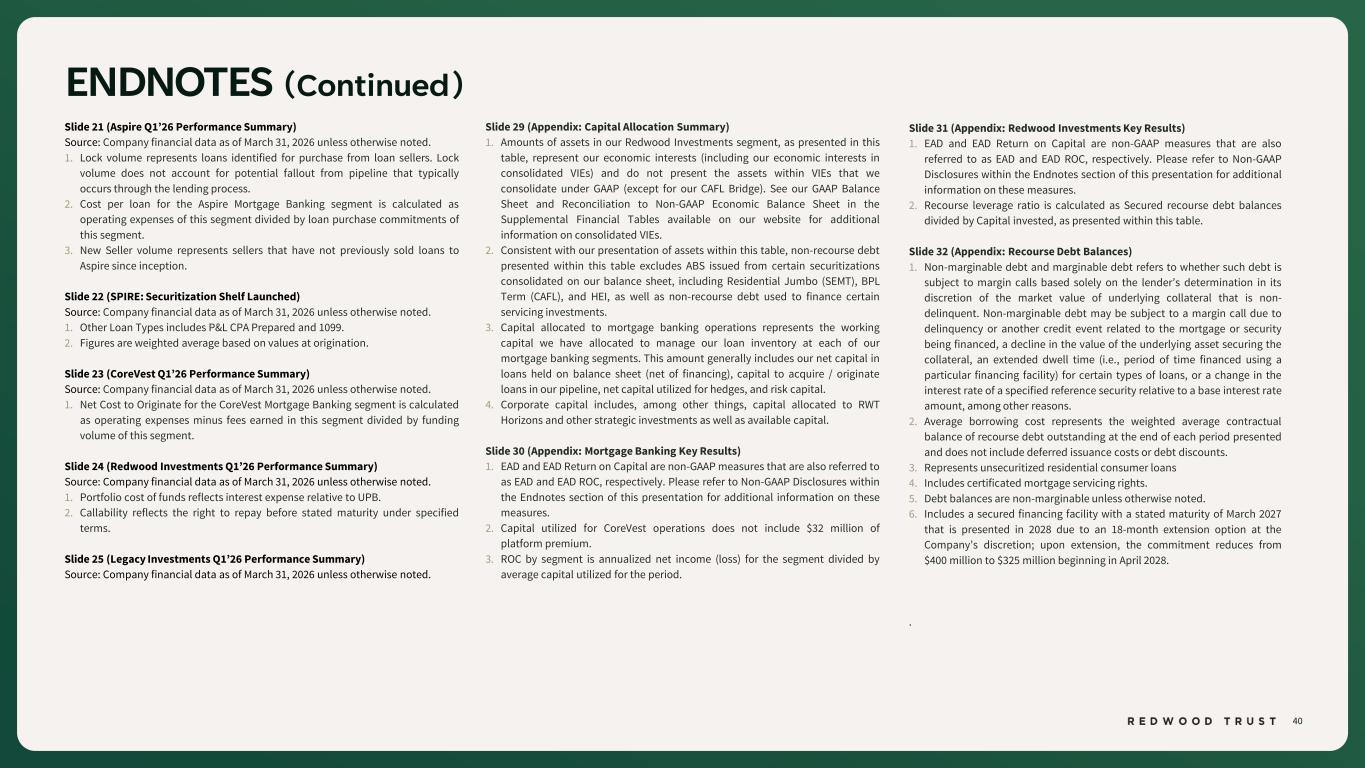
40 ENDNOTES (Continued) Slide 21 (Aspire Q1’26 Performance Summary) Source: Company financial data as of March 31, 2026 unless otherwise noted. 1. Lock volume represents loans identified for purchase from loan sellers. Lock volume does not account for potential fallout from pipeline that typically occurs through the lending process. 2. Cost per loan for the Aspire Mortgage Banking segment is calculated as operating expenses of this segment divided by loan purchase commitments of this segment. 3. New Seller volume represents sellers that have not previously sold loans to Aspire since inception. Slide 22 (SPIRE: Securitization Shelf Launched) Source: Company financial data as of March 31, 2026 unless otherwise noted. 1. Other Loan Types includes P&L CPA Prepared and 1099. 2. Figures are weighted average based on values at origination. Slide 23 (CoreVest Q1’26 Performance Summary) Source: Company financial data as of March 31, 2026 unless otherwise noted. 1. Net Cost to Originate for the CoreVest Mortgage Banking segment is calculated as operating expenses minus fees earned in this segment divided by funding volume of this segment. Slide 24 (Redwood Investments Q1’26 Performance Summary) Source: Company financial data as of March 31, 2026 unless otherwise noted. 1. Portfolio cost of funds reflects interest expense relative to UPB. 2. Callability reflects the right to repay before stated maturity under specified terms. Slide 25 (Legacy Investments Q1’26 Performance Summary) Source: Company financial data as of March 31, 2026 unless otherwise noted. Slide 31 (Appendix: Redwood Investments Key Results) 1. EAD and EAD Return on Capital are non-GAAP measures that are also referred to as EAD and EAD ROC, respectively. Please refer to Non-GAAP Disclosures within the Endnotes section of this presentation for additional information on these measures. 2. Recourse leverage ratio is calculated as Secured recourse debt balances divided by Capital invested, as presented within this table. Slide 32 (Appendix: Recourse Debt Balances) 1. Non-marginable debt and marginable debt refers to whether such debt is subject to margin calls based solely on the lender’s determination in its discretion of the market value of underlying collateral that is non- delinquent. Non-marginable debt may be subject to a margin call due to delinquency or another credit event related to the mortgage or security being financed, a decline in the value of the underlying asset securing the collateral, an extended dwell time (i.e., period of time financed using a particular financing facility) for certain types of loans, or a change in the interest rate of a specified reference security relative to a base interest rate amount, among other reasons. 2. Average borrowing cost represents the weighted average contractual balance of recourse debt outstanding at the end of each period presented and does not include deferred issuance costs or debt discounts. 3. Represents unsecuritized residential consumer loans 4. Includes certificated mortgage servicing rights. 5. Debt balances are non-marginable unless otherwise noted. 6. Includes a secured financing facility with a stated maturity of March 2027 that is presented in 2028 due to an 18-month extension option at the Company’s discretion; upon extension, the commitment reduces from $400 million to $325 million beginning in April 2028. . Slide 29 (Appendix: Capital Allocation Summary) 1. Amounts of assets in our Redwood Investments segment, as presented in this table, represent our economic interests (including our economic interests in consolidated VIEs) and do not present the assets within VIEs that we consolidate under GAAP (except for our CAFL Bridge). See our GAAP Balance Sheet and Reconciliation to Non-GAAP Economic Balance Sheet in the Supplemental Financial Tables available on our website for additional information on consolidated VIEs. 2. Consistent with our presentation of assets within this table, non-recourse debt presented within this table excludes ABS issued from certain securitizations consolidated on our balance sheet, including Residential Jumbo (SEMT), BPL Term (CAFL), and HEI, as well as non-recourse debt used to finance certain servicing investments. 3. Capital allocated to mortgage banking operations represents the working capital we have allocated to manage our loan inventory at each of our mortgage banking segments. This amount generally includes our net capital in loans held on balance sheet (net of financing), capital to acquire / originate loans in our pipeline, net capital utilized for hedges, and risk capital. 4. Corporate capital includes, among other things, capital allocated to RWT Horizons and other strategic investments as well as available capital. Slide 30 (Appendix: Mortgage Banking Key Results) 1. EAD and EAD Return on Capital are non-GAAP measures that are also referred to as EAD and EAD ROC, respectively. Please refer to Non-GAAP Disclosures within the Endnotes section of this presentation for additional information on these measures. 2. Capital utilized for CoreVest operations does not include $32 million of platform premium. 3. ROC by segment is annualized net income (loss) for the segment divided by average capital utilized for the period.
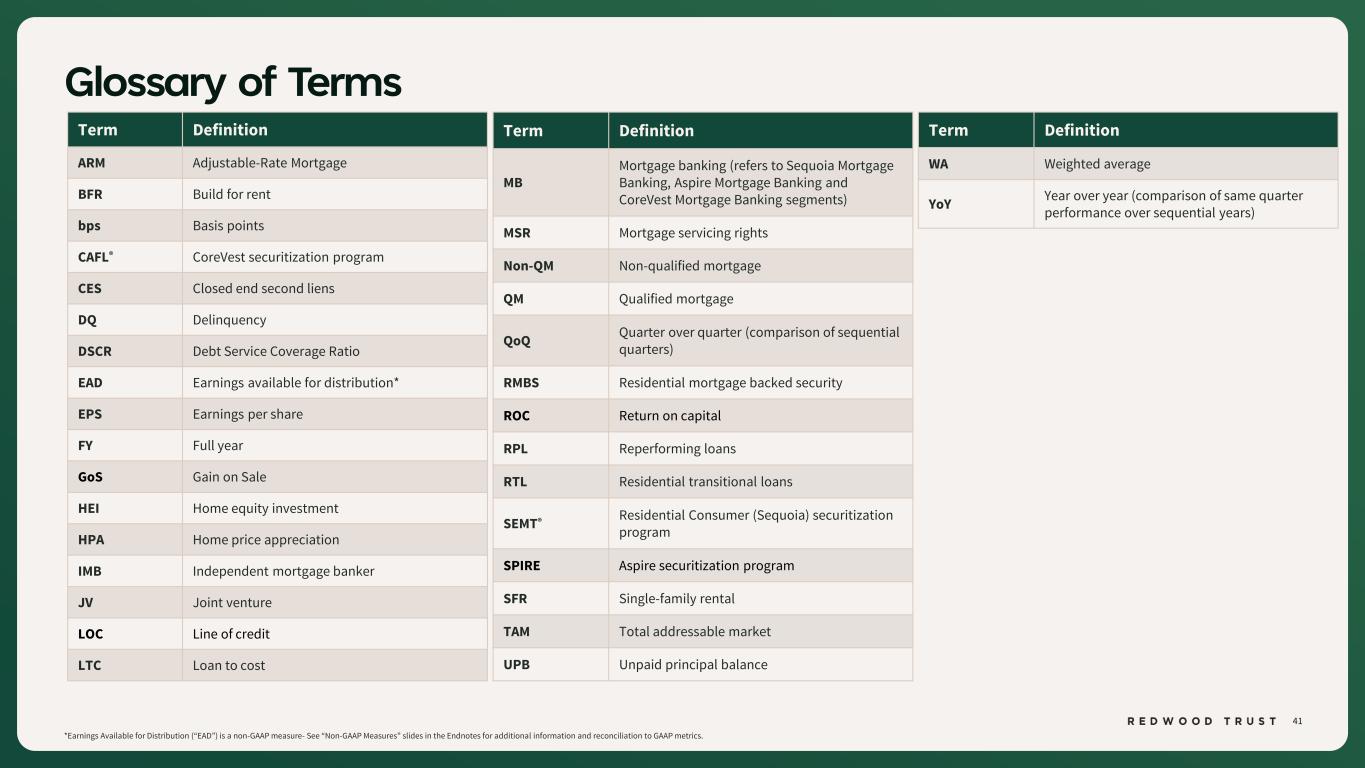
41 Glossary of Terms Term Definition ARM Adjustable-Rate Mortgage BFR Build for rent bps Basis points CAFL® CoreVest securitization program CES Closed end second liens DQ Delinquency DSCR Debt Service Coverage Ratio EAD Earnings available for distribution* EPS Earnings per share FY Full year GoS Gain on Sale HEI Home equity investment HPA Home price appreciation IMB Independent mortgage banker JV Joint venture LOC Line of credit LTC Loan to cost Term Definition MB Mortgage banking (refers to Sequoia Mortgage Banking, Aspire Mortgage Banking and CoreVest Mortgage Banking segments) MSR Mortgage servicing rights Non-QM Non-qualified mortgage QM Qualified mortgage QoQ Quarter over quarter (comparison of sequential quarters) RMBS Residential mortgage backed security ROC Return on capital RPL Reperforming loans RTL Residential transitional loans SEMT® Residential Consumer (Sequoia) securitization program SPIRE Aspire securitization program SFR Single-family rental TAM Total addressable market UPB Unpaid principal balance *Earnings Available for Distribution (“EAD”) is a non-GAAP measure- See “Non-GAAP Measures” slides in the Endnotes for additional information and reconciliation to GAAP metrics. Term Definition WA Weighted average YoY Year over year (comparison of same quarter performance over sequential years)